
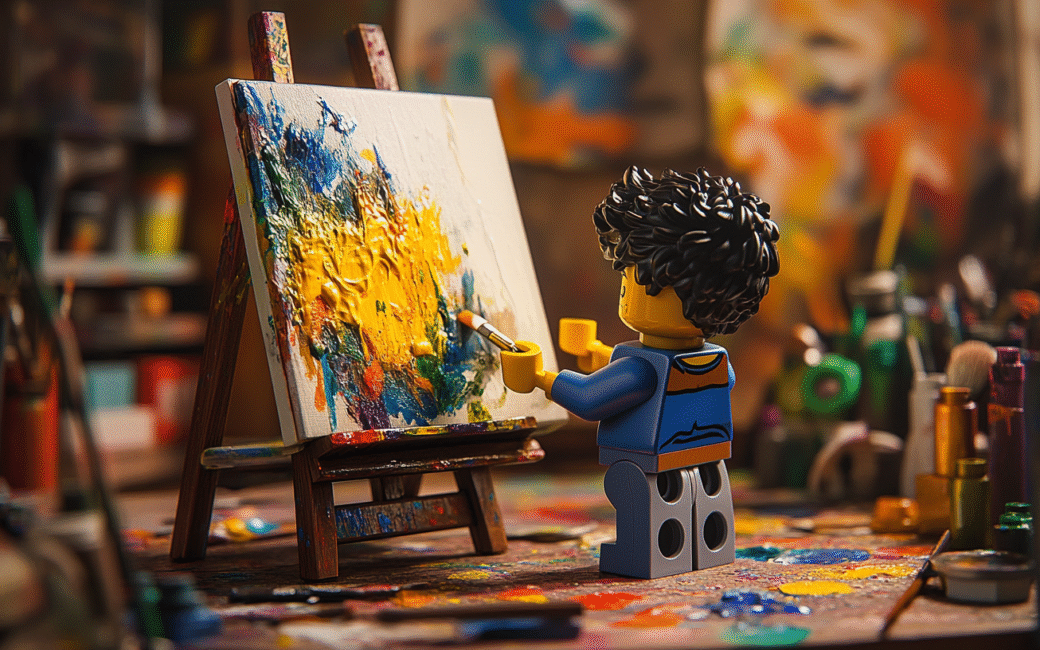
In 1961, Andy Warhol painted Campbell’s soup cans. He wasn’t trying to be fancy. He just wanted to show that everyday objects could be art. Fast forward to now and we’re still figuring out where the line is. What counts as real art? Is it a canvas? A mural? A performance in a gallery space?
Or could it be a tiny plastic figure with a mohawk, a sword, and a glow-in-the-dark chicken?
Some people would laugh at that last one. I wouldn’t. And I think if you’ve spent time around street art or at one of those chaotic, beautiful ArtLoveMagic events, you’d get it. Customized minifigs have started showing up in places where people don’t expect them. They’re weird, small, sometimes political, sometimes just funny. And they might actually be saying something worth hearing.
A Different Kind of Canvas
Minifigs are made for play. That’s their origin. But like any object, they can be repurposed. Artists cut them, repaint them, melt them, turn them into sculptures. They modify the pieces to say something different from what they were designed to say.
You can see this happening in the same way graffiti tags became full-blown murals or how a sketch on a napkin can be sold for more than the meal that created it. Minifigs, when customized, hold this strange tension. They are toys. But also, they are characters. Stories. Archetypes. Commentary.
And the best part? You don’t need a museum.
Street Corners and Toy Shelves
One of the most interesting things about street art is that it shows up where you live. It’s not tucked away behind a ticket counter. It’s on the electrical box near your bus stop. It’s on the back of a no parking sign. It blends in until it doesn’t.
I’ve seen people do the same with minifigs. They leave them in city cracks. Stick them on ledges. Glue them to abandoned newspaper stands. Sometimes they’re dressed like local politicians. Sometimes like punk rockers or skeletons in tiny business suits. They can be funny. They can be angry. Either way, they say something.
It’s strange how effective they are. Maybe because they look harmless. Maybe because they’re small enough to be ignored until someone takes a second glance.
Customizing the Commentary
For artists, the minifig is a modular body. A blank human-ish shape that can be changed over and over again. It doesn’t have to start blank. Most don’t. But the customization gives artists full control. They can change the expression. The outfit. Add wings or helmets or a broken heart painted on the chest. You can tell a whole story in just a few inches of plastic.
I’ve watched people build whole dioramas just to photograph one minifig in the middle of it. I’ve seen stop-motion videos using these things that say more in sixty seconds than some art installations say in an hour. And I’ve seen enough one-off customs to know that minifigs are more than just collectibles. They’re tools.
I get mine from minifig.biz. And yeah, I’ve gone through a bunch of other places, but that site seems to have all of the weird minifigs you can’t get elsewhere. The kind that make you laugh but also make you wonder who had the idea in the first place.
Art Is About Intent
Some people still get stuck on the material. They think something has to be oil on canvas or welded from steel to count. But that’s not how this works. Art is about what you’re trying to say. It’s about pushing an idea out into the world using whatever you can hold in your hand.
Minifigs work because they’re familiar. They remind you of childhood. Of building something that didn’t need instructions. But when you twist that familiarity — when you put a skeleton in a tuxedo or a space knight in roller skates — it creates tension. And tension is where art starts.
Think about this. If someone sees a six-foot sculpture of a corporate robot in a gallery, they might nod. But if someone finds a tiny version of that same robot glued to the back of a city bench, holding a protest sign the size of a penny, they’re going to stop and think. Probably snap a photo. Probably share it.
And that’s what makes it interesting. It’s not just that minifigs can look like anything. It’s that they can show up anywhere.
Low Barriers and High Imagination
There’s something democratic about using minifigs in art. You don’t need a huge studio. You don’t need to spend thousands on supplies. You don’t even need approval. You just need an idea and the right parts.
I’ve seen teenagers make better commentary with a Sharpie and a minifig than some full-grown adults with degrees and gallery space. That doesn’t mean one is better than the other. It just means access matters. And when you can access something that lets you express a message — especially in a way people recognize — it opens doors.
That’s why I think these little figures matter. And why I keep coming back to minifig.biz. There’s always something new there. Something that makes me think, “Oh, I could turn this into a version of my high school principal” or “This looks like the villain from my dream last week.”
And sometimes that’s enough to get me started.
Small Doesn’t Mean Simple
Just because something is small doesn’t mean it’s shallow. We know this from haikus. From short films. From Post-it notes on a mirror.
A customized minifig is like that. It’s short-form expression. It’s tight, it’s punchy, and if you do it right, it sticks with people. That’s the goal, right? Whether you’re painting on a wall or snapping a photo of a minifig flipping the bird on top of a parking meter, you want someone to feel something. To think about it later. To smile or frown or share it.
That’s art. Even if it’s tiny. Even if it’s made of plastic.
And if someone’s still not convinced, that’s okay. Just wait. Because the next time they walk past a stop sign and see a one-inch wizard battling a zombie accountant with a calculator sword, they might finally get it.