TLDR
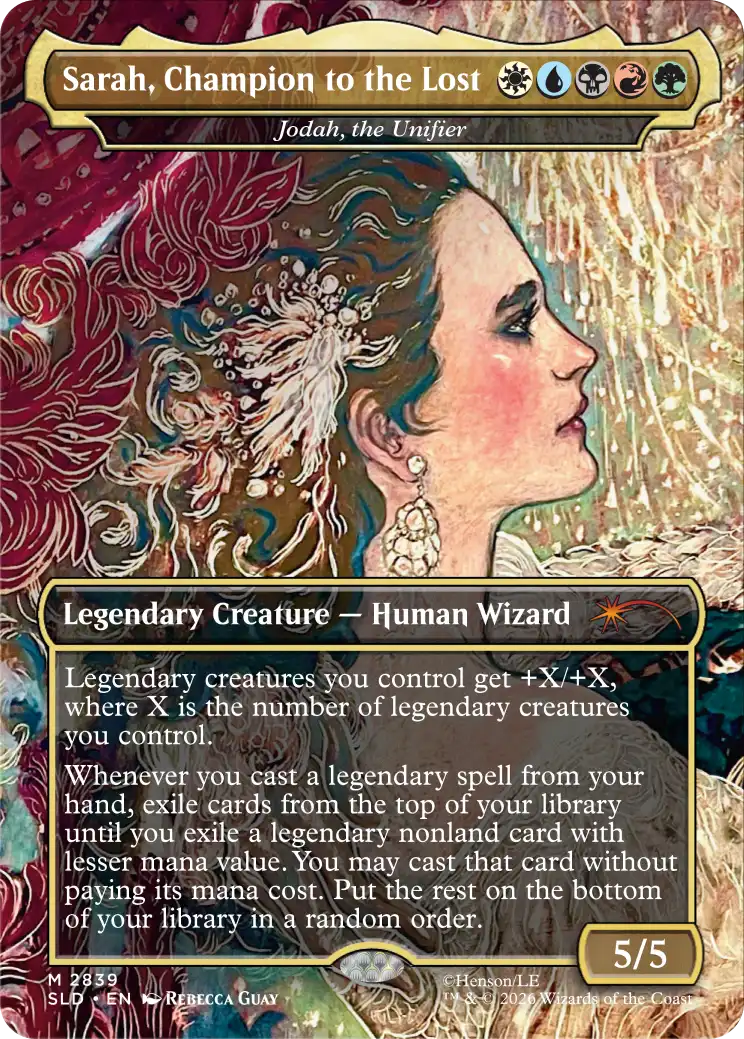
The Labyrinth Secret Lair linked artwork is more than a pair of coordinated character treatments. Wizards says Sarah, Champion to the Lost and Jareth, Goblin King come from the same Rebecca Guay piece and form a two-card scene. Each card can stand alone as a portrait, but placing them together restores the relationship at the center of the composition. The catch is that the two halves are divided between separate Secret Lair drops.
That split changes the collecting question. Buying one card gives you a recognizable character image; completing both drops gives you the release’s strongest artistic idea. The pair turns Magic’s frames into a deliberate seam between two viewpoints, making the cards feel less like isolated alternates and more like a small, display-oriented fantasy-art series.
What the Labyrinth Secret Lair linked artwork confirms
Wizards of the Coast announced the eight-drop Secret Lair: Corn Maze Superdrop on September 30, 2026. Its official Corn Maze Superdrop announcement identifies the Sarah and Jareth illustrations as originating from the same piece and describes the result as a “two-card scene.” That wording matters: Wizards confirms a compositional relationship, not merely similar palettes, matching frames, or two portraits commissioned around the same theme.
The cards are mechanically familiar Magic designs wearing Labyrinth identities. Sarah, Champion to the Lost is a treatment of Jodah, the Unifier, while Jareth, Goblin King is a treatment of Muxus, Goblin Grandee. The official card imagery credits Rebecca Guay on both cards.
| Labyrinth card | Magic card treated | Secret Lair drop | Visual role |
|---|---|---|---|
| Sarah, Champion to the Lost | Jodah, the Unifier | Should You Need Us | One half of the shared two-card scene |
| Jareth, Goblin King | Muxus, Goblin Grandee | Fear Me, Love Me | The corresponding half of the shared scene |
Calling this a two-card scene is more accurate than calling it an uninterrupted panorama. A panorama implies that adjoining the cards reveals an open, continuous image. These remain playable Magic cards, with frames, names, type lines, rules text, and other game information occupying visual space. The source illustration connects them, but the card objects still interrupt it.
One card presents a character; two cards present a relationship
A single trading-card frame is naturally good at making one subject feel important. Its vertical proportions, enclosing border, title area, and rules box all encourage the viewer to read the illustration as a contained character image. Sarah alone therefore functions as a Sarah collectible. Jareth alone functions as a Jareth collectible. Neither becomes visually meaningless when separated from the other.
The shared source changes that reading without erasing it. Once the cards are recognized as adjacent parts of one piece, empty space, cropping, character placement, and the direction of the composition stop belonging exclusively to one portrait. They become evidence of an encounter extending beyond each card’s edge. The viewer is no longer looking only at who occupies a frame, but at how two framed figures occupy a larger scene together.
That is the difference between matching art and linked art. Matching works can establish a collection through repeated color, rendering, costume, or ornament. Linked works add spatial dependency. One image tells the viewer that something continues outside it; the second supplies the missing counterpart.
For readers interested in why certain pieces of MTG card art stay memorable, this is a particularly clear example of format shaping interpretation. The cards do not merely reproduce an illustration at a smaller size. They make separation part of the experience: first you encounter a character, then you discover that the frame is one side of a larger visual exchange.
The card frame is both the clever device and the limitation
The most interesting formal choice is also the most obvious obstruction. Two card frames make the connection collectible. They create a satisfying before-and-after moment when the separate objects are placed together, and they let each character retain an individual identity in a deck, binder, or display.
Those same frames prevent the pair from behaving like an unobstructed art print. Even when positioned correctly, the viewer must mentally bridge borders and interface elements. Titles and rules text keep pulling the cards back toward their game functions. That tension is not necessarily a defect. It is what makes the project specifically card art rather than an illustration cut into two ordinary rectangular prints.
The result rewards two viewing distances. From farther away, the cards can read as a coordinated pair with a shared visual rhythm. Up close, each one returns to being an individual Magic object with its own name, underlying game identity, and text. Collectors who enjoy artist proofs, signatures, and other objects that foreground the illustrator’s contribution may find that dual identity especially appealing; it resembles the broader movement from liking a card to collecting around its artist and artwork.
Labyrinth context strengthens the pair without proving a direct recreation
Sarah and Jareth already carry a relationship that viewers of Labyrinth bring to the cards. The film’s ballroom material is a particularly relevant point of atmosphere: The Jim Henson Company archive documents June 19–25, 1985, as the filming period for the ballroom sequence. That history helps explain why an ornate, relationship-centered pairing feels appropriate to these characters.
It does not prove that Guay’s artwork recreates a particular film frame, however. Without an artist statement or a direct production note, the responsible reading is narrower: the two-card format can evoke the visual tension and heightened fantasy atmosphere associated with Sarah and Jareth, while Wizards confirms only that the card images come from the same piece. The distinction leaves room for visual interpretation without assigning an undocumented intention to the artist.
Completing the image requires two separately sold drops
The collector tradeoff is unusually concrete because Sarah and Jareth are not packaged in the same Labyrinth drop. Jareth appears in Fear Me, Love Me, while Sarah appears in Should You Need Us. Someone buying directly for the complete scene therefore needs both products, not simply two cards from one drop.
Wizards lists each Labyrinth drop at $29.99 in non-foil and $39.99 in foil. At those listed prices, acquiring both complete drops would total $59.98 in non-foil or $79.98 in foil before any applicable taxes or shipping. That calculation should not be mistaken for the price of the linked artwork alone: each purchase includes its drop’s other cards. It does show that completing this particular composition involves a materially different commitment from choosing one favorite character.
There is no supplied evidence that the separation was designed as a scarcity tactic, so the stronger criticism is about experience rather than motive. The release’s best compositional idea crosses a product boundary. For a buyer interested mainly in Sarah or Jareth, that boundary is harmless. For someone attracted specifically by the connected art, it turns completion into a two-drop decision.
Should you collect one card or complete the pair?
The answer depends on what you want the object to do. Treat the cards as individual collectibles if character attachment, deck use, or one underlying Magic card matters most. Treat them as a pair if the shared composition is the reason the release caught your attention.
- Choose Sarah alone if Sarah is the focal character for your collection or Jodah is the card you expect to use.
- Choose Jareth alone if the character portrait or Muxus treatment is the primary appeal.
- Complete the pair if you want the officially confirmed two-card scene, especially for a binder spread or side-by-side display.
- Before buying, decide whether you value foil treatment more than consistent surface appearance and easy viewing. Whatever finish you choose, matching both cards will usually make the visual relationship feel more coherent.
- Do not assume the pair becomes a seamless print. The Magic frames and text remain part of how the artwork is encountered.
This is the same principle that makes a visually cohesive cube or themed deck feel intentional: repetition helps, but relationships do more work. A group becomes a visual system when one object changes how another is read. Readers building larger projects can apply that idea when choosing art for a Magic cube that feels like a gallery—look for images that converse through composition, atmosphere, scale, or recurring motifs rather than merely sharing a broad genre.
The pair is the artwork’s most complete form
Sarah and Jareth remain functional standalone treatments, and collectors should not feel that one card is incomplete as an object. Each still offers a character-focused image attached to a playable Magic identity. But the most distinctive feature of this Labyrinth release exists between the cards, not entirely within either one.
That makes the pair more compelling than the sum of two alternate treatments. The frames isolate the characters, then reveal that the isolation is conditional. Place the cards together and the borders become a hinge connecting two views of one piece. For an art-first collector, that shared compositional idea—not simply the crossover name—is the strongest reason to complete the scene.