Best Commander Staples To Proxy For Budget Players

Commander should not be a wallet measuring contest.

That does not mean collections are meaningless. It does not mean expensive cards are bad. It does not mean every table has to allow every proxy. But Commander is at its best when players get to build interesting decks, play real games, and explore the format without feeling like they are priced out before the first land drop.

That is where proxies can help.

For budget players, MTG proxies are not just about pretending to own expensive cards. Used well, they are a way to test deck ideas, smooth out mana bases, play with iconic staples, and sit down at a Commander table without feeling punished for not having bought certain cards years ago.

The key phrase is “used well.”

The best cards to proxy for Commander are not always the most expensive cards. They are the cards that make your deck function, help your pod play better games, and let you experience the format without turning every upgrade into a financial decision.

This guide focuses on the best Commander staples to proxy for budget players, with one important rule in mind:

Proxy to improve gameplay, not to secretly overpower the table.

Before You Proxy: A Few Commander Rules Of Thumb

Before we get into the card categories, let’s be clear about a few things.

First, proxies are for casual play, testing, and table-approved games. If you are playing in a sanctioned event or any event where authentic Magic cards are required, proxies are not the same as real cards.

Second, always check the current Commander ban list before proxying powerful cards. Some of the most famous and expensive cards in Magic are not legal in Commander. Do not build your proxy plan around banned cards unless your group specifically plays with house rules.

Third, talk to your pod. Commander is a social format. Your table may be completely fine with proxies. They may allow proxies only for cards you own. They may allow proxy mana bases but not proxy fast mana. They may allow full proxy decks. They may allow none at all.

The healthy approach is simple:

“I’m using proxies for some expensive staples and lands. The deck is aiming for mid-power, not cEDH. Is that okay?”

That sentence prevents most problems.

The Best Staples To Proxy First: Lands

If you are a budget Commander player, your first proxy priority should usually be your mana base.

Not flashy finishers. Not the most annoying blue spell at the table. Not a pile of tutors. Lands.

A better mana base does not always make your deck oppressive. It often just lets your deck play the game. You get to cast your commander on time. You get to keep more opening hands. You get fewer games where you stare at three lands and none of them produce the color you need.

That is a good use of proxies.

Fetch Lands

Fetch lands are some of the best lands to proxy because they make multicolor Commander decks smoother and more consistent.

Examples include:

  • Flooded Strand
  • Polluted Delta
  • Bloodstained Mire
  • Wooded Foothills
  • Windswept Heath
  • Marsh Flats
  • Scalding Tarn
  • Verdant Catacombs
  • Arid Mesa
  • Misty Rainforest
  • Prismatic Vista

Fetch lands are especially useful in three-color, four-color, and five-color decks. They also work well with landfall, graveyard synergies, top-deck manipulation, and cards with basic land types.

For budget players, fetch lands are one of the cleanest proxy choices because they solve a real gameplay problem: bad mana.

They do make decks stronger, but usually in a way that makes games better rather than more miserable.

Shock Lands

Shock lands are another great proxy target.

Examples include:

  • Hallowed Fountain
  • Watery Grave
  • Blood Crypt
  • Stomping Ground
  • Temple Garden
  • Godless Shrine
  • Steam Vents
  • Overgrown Tomb
  • Sacred Foundry
  • Breeding Pool

Shock lands are strong because they have basic land types, which means fetch lands can find them. A fetch-shock mana base is not required for casual Commander, but it makes multicolor decks much more reliable.

If you are proxying fetch lands, shock lands are the natural next step.

Triomes And Three-Color Lands

Three-color decks often feel dramatically better with the right lands.

Good proxy options include:

  • Indatha Triome
  • Ketria Triome
  • Raugrin Triome
  • Savai Triome
  • Zagoth Triome
  • Jetmir’s Garden
  • Raffine’s Tower
  • Spara’s Headquarters
  • Xander’s Lounge
  • Ziatora’s Proving Ground

Triomes are excellent in Commander because they fix three colors, have basic land types, and can be cycled later. They are not the fastest lands in the world, but they make greedy mana much easier.

If your Commander deck is three colors and constantly stumbles, triomes are very reasonable proxies.

Battlebond Lands

The Battlebond-style multiplayer lands are excellent in Commander because they usually enter untapped in multiplayer games.

Examples include:

  • Sea of Clouds
  • Morphic Pool
  • Luxury Suite
  • Spire Garden
  • Bountiful Promenade
  • Training Center
  • Vault of Champions
  • Spectator Seating
  • Rejuvenating Springs
  • Undergrowth Stadium

These are some of the best “fair but strong” lands to proxy. They do not create explosive starts by themselves. They just help your deck function.

That is exactly what budget proxies should do.

Utility Lands

Some utility lands are expensive because they provide powerful effects from a land slot. These are worth proxying when they fit your deck’s plan.

Good examples include:

  • Boseiju, Who Endures
  • Otawara, Soaring City
  • Takenuma, Abandoned Mire
  • Eiganjo, Seat of the Empire
  • Ancient Tomb
  • Cavern of Souls
  • Urborg, Tomb of Yawgmoth
  • Yavimaya, Cradle of Growth
  • Nykthos, Shrine to Nyx
  • Field of the Dead
  • The Mycosynth Gardens

These are more deck-dependent than fetches or shocks. Boseiju is broadly useful. Cavern of Souls is great for tribal decks. Nykthos is excellent in devotion-heavy decks. Field of the Dead belongs in land-focused decks. Ancient Tomb is powerful and should be discussed with the table if your pod is lower power.

In general, utility lands are great proxies when they support a theme rather than simply jamming maximum efficiency into every deck.

Expensive Card Draw And Value Engines

After mana, the next best proxy category is card advantage.

Commander games are long. Players cast sweepers. Boards get removed. Hands run empty. The decks that feel best are often the decks that can keep playing after the first wave of interaction.

That is why card draw and value engines are great proxy targets.

Rhystic Study

Rhystic Study is one of the most famous blue Commander staples for a reason. It either draws a lot of cards or taxes opponents repeatedly.

It is also the kind of card you should mention before a game if your pod is casual. Some tables are completely used to it. Others find it annoying.

Proxy it if you want to test blue value engines, but understand that it changes the feel of a game.

Mystic Remora

Mystic Remora is cheaper mana-wise than Rhystic Study and can be even more explosive in the right pod. It is especially strong against decks full of artifacts, ramp, and cheap noncreature spells.

It is a good proxy for higher-power casual and cEDH-adjacent games, but it may feel out of place in slow battlecruiser pods.

Esper Sentinel

Esper Sentinel is one of white’s best early value pieces. It gives white decks a way to keep up with faster players and punish opponents for taking multiple noncreature actions.

If you play white often, Esper Sentinel is a very reasonable proxy target. It goes in many decks without requiring a complicated build-around.

The One Ring

The One Ring is powerful card draw, protection, and inevitability in one artifact. Because it can go in any color identity, it is tempting to proxy everywhere.

Be careful with that.

The One Ring is strong enough that some tables may want to know about it before the game starts. It is a great test proxy, but it should not become an automatic inclusion in every casual deck unless your group is comfortable with that level of power.

Sylvan Library

Sylvan Library is a classic green card-selection engine. It is excellent in decks that care about the top of the library, life gain, card quality, or long-term value.

This is a good proxy for green players who want a smoother deck without jumping straight into combo territory.

Necropotence

Necropotence is one of the most powerful black card advantage engines ever printed. It is legal in Commander, but it is also a serious power card.

Proxying Necropotence is reasonable if you want to test strong black decks, but it is not a casual “oops, just value” card. It can completely change how a deck plays.

Mention it in the pregame conversation.

Expensive Interaction Worth Proxying

Budget Commander decks often lose not because their win conditions are bad, but because they cannot interact at the right time.

That makes interaction one of the healthiest proxy categories. A table where players can stop runaway threats is usually better than a table where one player snowballs because nobody had an answer.

Fierce Guardianship

Fierce Guardianship is one of the strongest free counterspells in Commander. It is excellent because it lets you tap out for your commander or a big play while still protecting yourself.

It is also a card that pushes a deck’s power level upward.

Proxying Fierce Guardianship is totally reasonable for higher-power pods, but it can feel excessive in casual games where players expect shields to be down after someone taps out.

Deflecting Swat

Deflecting Swat is one of the best red protection spells in the format. It can protect a commander, redirect removal, mess with targeted effects, and create huge blowouts.

It is also exactly the kind of card that budget red players often wish they had access to.

This is a strong proxy choice for commander-focused red decks, especially if your table already plays efficient interaction.

Deadly Rollick

Deadly Rollick gives black decks free creature exile when their commander is out. It is clean, efficient, and easy to include.

This is a great proxy for black decks that need better removal, especially in pods where creature-based commanders are common.

Teferi’s Protection

Teferi’s Protection is one of white’s most iconic defensive spells. It can save your board, protect your life total, and completely blank a lethal turn.

It is a very reasonable proxy for white Commander decks, especially if your group plays big swingy turns. Just know that some players dislike how hard it can be to play around.

Cyclonic Rift

Cyclonic Rift is one of the most famous blue Commander staples and one of the easiest cards to argue about.

On one hand, it is a clean answer to overwhelming board states. On the other hand, overloaded Cyclonic Rift often turns into “reset everyone else, then win.”

This is a good proxy if your table already plays at a strong power level. It is not always a good proxy for relaxed casual pods.

Force Of Will And Force Of Negation

Free counterspells are powerful because they let a player interact without leaving mana open. In high-power Commander, that matters a lot. In casual Commander, it can feel like the blue player is never truly vulnerable.

Proxy these if you are testing high-power decks, cEDH decks, or pods where fast combo exists. Be cautious about bringing them into low-power games.

Tutors: Useful, But Handle Carefully

Tutors are some of the most tempting cards to proxy because they make decks more consistent. They also tend to make Commander games feel more repetitive.

That does not mean tutors are bad. They are a major part of Magic. But budget players should think carefully before proxying every expensive tutor into every deck.

A deck with one tutor for a theme card feels very different from a deck with six tutors that always finds the same combo.

Demonic Tutor

Demonic Tutor is simple, efficient, and powerful. It finds anything.

That is both why it is great and why it should be disclosed. If your deck uses Demonic Tutor to find a fun build-around piece, most tables will not care. If it always finds a two-card win condition, the game changes.

Vampiric Tutor

Vampiric Tutor is even more efficient than Demonic Tutor in some situations because it costs only one mana and can be cast at instant speed.

This is a high-power proxy target. It is excellent, but it is not subtle.

Enlightened Tutor

Enlightened Tutor is perfect for artifact and enchantment decks. It is especially useful in equipment decks, enchantress decks, pillowfort decks, and decks built around one key artifact.

This is a good proxy when it supports a clear strategy. It is more questionable when it only exists to find the same lock piece every game.

Worldly Tutor

Worldly Tutor is great for creature decks. It can find a key combo creature, a utility creature, a finisher, or a missing engine piece.

This is a strong but fair-feeling proxy in many green creature decks, depending on what it usually searches for.

Finale Of Devastation

Finale of Devastation is both a tutor and a win condition. It can find a key creature early or end the game later with enough mana.

It is a great proxy for creature-heavy decks, but it can also make green decks feel very samey if it always finds the same finisher.

Big Finishers And Deck-Defining Staples

Some cards are worth proxying because they define entire archetypes. These are not necessarily cards you jam into every deck. They are cards that make specific decks work.

That is a great use case for budget proxies.

Craterhoof Behemoth

Craterhoof Behemoth is the classic green creature finisher. Token decks, elf decks, and creature-swarm decks often want access to it.

It is powerful, but it also ends the game in a clear way. For many tables, that is preferable to a game dragging on for another hour.

Proxy Craterhoof if your deck’s plan is to build a board and win through combat. Just be honest that the deck has a real finisher.

Doubling Season

Doubling Season is a dream card for token decks, counter decks, planeswalker decks, and many casual strategies. It is expensive because it is beloved and splashy.

This is one of the best “fun expensive card” proxies. It is powerful, but it often supports exactly the kind of big, expressive Commander gameplay people enjoy.

Parallel Lives And Anointed Procession

Token decks love these effects. Parallel Lives and Anointed Procession do not belong everywhere, but they are excellent in decks that want them.

These are great proxy choices because they let budget players experience a real version of a token deck instead of a watered-down version.

Smothering Tithe

Smothering Tithe is one of white’s most powerful ramp engines. It can generate huge amounts of Treasure and pull white decks ahead.

It is a good proxy, but it is also a card people may groan at. If your pod already plays strong engines, it is fine. If your pod is casual and slow, Smothering Tithe can take over.

Avacyn, Angel Of Hope

Avacyn is not a universal staple, but she is a classic expensive Commander card for angel decks, big white decks, and battlecruiser strategies.

This is a great example of a proxy that is more about letting someone play their dream deck than crushing the table. If someone wants to build angels, they should not have to abandon the deck because one iconic card is expensive.

Eldrazi Titans

Cards like Kozilek, Butcher of Truth, Ulamog, the Ceaseless Hunger, and other huge Eldrazi are popular in big mana decks.

These are reasonable proxies if your deck is built to cast giant threats. They are less reasonable if your table hates annihilator-style gameplay or fast cheat effects.

As always, ask first.

Cards Budget Players Usually Should Not Proxy First

Not every expensive Commander card should be a proxy priority.

Some cards are expensive but not necessary. Some are banned. Some are so powerful that they change the whole pod. Some are simply less useful than fixing your mana or improving your interaction.

Do Not Prioritize Banned Cards

Do not proxy banned Commander cards for normal Commander games. It does not matter how famous or expensive they are.

This includes cards like:

  • Black Lotus
  • Mox Sapphire
  • Mox Jet
  • Mox Ruby
  • Mox Emerald
  • Mox Pearl
  • Mana Crypt
  • Jeweled Lotus
  • Dockside Extortionist
  • Nadu, Winged Wisdom
  • Hullbreacher
  • Golos, Tireless Pilgrim

If your group has a special house-rule night, that is different. But for normal Commander, banned cards are not good proxy targets.

Do Not Waste Proxies On Cheap Staples

Some Commander staples are already affordable. You usually do not need to proxy cards like:

  • Sol Ring
  • Arcane Signet
  • Command Tower
  • Swords to Plowshares
  • Beast Within
  • Generous Gift
  • Chaos Warp
  • Reality Shift
  • Cultivate
  • Kodama’s Reach

Prices always change, but the general idea holds: save your proxy slots for cards that are actually keeping you from building the deck.

Be Careful With Fast Mana

Fast mana is one of the quickest ways to change a Commander game.

Cards like Mana Vault, Chrome Mox, Mox Diamond, Grim Monolith, and Ancient Tomb can be legal depending on the card, but they push decks upward fast.

That does not mean you should never proxy them. They are important in high-power and cEDH environments. But if your table is casual, proxying fast mana is very different from proxying a better dual land.

Fast mana should always be part of the pregame conversation.

Be Careful With Full Tutor Packages

One tutor can help a deck find its theme. Six tutors can make a deck play the same way every game.

If your goal is budget access and fun Commander, do not automatically proxy every expensive tutor. Proxy the ones that make your deck work, not the ones that turn every game into the same script.

Best Proxy Priorities By Deck Type

Different decks need different staples. Here is a simple way to think about proxy priorities.

Three-Color Casual Decks

Start with lands.

Proxy fetch lands, shock lands, triomes, and Battlebond lands before anything else. A smoother mana base will improve every game without necessarily making your deck oppressive.

Good proxy targets:

  • Fetch lands
  • Shock lands
  • Triomes
  • Battlebond lands
  • Boseiju, Who Endures
  • Otawara, Soaring City

Token Decks

Token decks benefit from expensive multiplier effects and finishers.

Good proxy targets:

  • Doubling Season
  • Parallel Lives
  • Anointed Procession
  • Mondrak, Glory Dominus
  • Craterhoof Behemoth
  • Finale of Devastation

Creature Toolbox Decks

Creature decks often want tutors and utility lands.

Good proxy targets:

  • Worldly Tutor
  • Finale of Devastation
  • Green Sun’s Zenith
  • Cavern of Souls
  • Yavimaya, Cradle of Growth
  • Nykthos, Shrine to Nyx

Blue Control Decks

Blue decks often want efficient card draw and stack interaction.

Good proxy targets:

  • Rhystic Study
  • Mystic Remora
  • Cyclonic Rift
  • Fierce Guardianship
  • Force of Will
  • Force of Negation
  • Otawara, Soaring City

White Value Decks

White decks appreciate protection, card advantage, and catch-up ramp.

Good proxy targets:

  • Esper Sentinel
  • Smothering Tithe
  • Teferi’s Protection
  • Trouble in Pairs
  • Land Tax
  • Eiganjo, Seat of the Empire

Black Combo Or Aristocrats Decks

Black decks often want efficient tutors, draw, and recursion.

Good proxy targets:

  • Demonic Tutor
  • Vampiric Tutor
  • Necropotence
  • Deadly Rollick
  • Takenuma, Abandoned Mire
  • Phyrexian Tower

Tribal Decks

Tribal decks benefit from mana consistency and creature protection.

Good proxy targets:

  • Cavern of Souls
  • Kindred Discovery
  • Roaming Throne
  • Herald’s Horn
  • Urza’s Incubator
  • The Great Henge

Using ProxyKing Or Other Proxy Services

For casual Commander, some players use paper printouts in sleeves. Others prefer cleaner, more readable proxy cards from a service like ProxyKing.

The advantage of using a dedicated proxy service is readability. A clean proxy is easier for the table to understand than a blurry home printout or a basic land with marker text. That matters more than people think. Commander board states already get complicated. Nobody wants to keep asking what every card is supposed to be.

That said, a high-quality proxy is still a proxy. It should not be passed off as a real card. It should not be traded as authentic. It should not be used in events that require official cards.

The best use case is simple: casual games, deck testing, clear communication, and table approval.

A Healthy Proxy Philosophy For Budget Players

The healthiest proxy philosophy is not “proxy everything expensive.”

It is this:

Proxy the cards that let your deck play real games.

That usually means:

  • Fixing your mana
  • Giving your deck enough card draw
  • Adding interaction so you can answer threats
  • Testing expensive cards before buying them
  • Supporting the deck’s main theme
  • Avoiding cards that make your pod miserable

A budget player should not feel embarrassed for proxying a mana base. They should not be locked out of an archetype because one enchantment costs too much. They should not have to build a weaker, clunkier version of every deck just because they started collecting later than everyone else.

At the same time, proxying should not become a way to ignore the social contract. If your friends are playing upgraded precons, do not show up with a fully proxied optimized combo deck and pretend the issue is “budget.” That is not budget access. That is a power mismatch.

Commander works best when everyone gets to play the kind of game they sat down for.

A Simple Proxy Priority List

If you are not sure where to start, use this order:

1. Proxy Lands First

Start with lands that make your deck function.

Fetch lands, shock lands, triomes, Battlebond lands, and important utility lands will improve your deck without making every game feel the same.

2. Proxy Interaction Second

Add the cards that help you stop runaway games.

Good interaction creates better Commander. Fierce Guardianship, Deflecting Swat, Deadly Rollick, Teferi’s Protection, and Cyclonic Rift are all strong options, depending on your pod’s power level.

3. Proxy Card Draw Third

Make sure your deck can keep playing.

Rhystic Study, Esper Sentinel, Mystic Remora, Sylvan Library, Necropotence, and The One Ring are all powerful, but they should be matched to the table.

4. Proxy Deck-Defining Cards Fourth

This is where you proxy the cards that make your deck feel complete.

Doubling Season for tokens. Craterhoof for creature swarms. Cavern of Souls for tribal. Avacyn for angels. Urborg for black decks. Nykthos for devotion.

5. Proxy Tutors Last

Tutors are strong, but they also make decks more consistent and repetitive. Use them carefully.

If your tutor finds a theme card, great. If it finds the same combo every game, tell the table what kind of deck you are really playing.

Final Thoughts: Proxy For Better Games, Not Bigger Flexes

The best Commander staples to proxy are not just the cards with the highest price tags. They are the cards that make your deck function, make games more interactive, and let budget players participate fully.

For most players, that starts with lands. Then interaction. Then card draw. Then deck-defining staples. Then, carefully, tutors and fast mana.

Proxies are good for Commander when they make the format more accessible. They are good when they let players test cards before spending money. They are good when they help someone build the angel deck, token deck, tribal deck, lands deck, or control deck they actually wanted to play.

They are bad when they are hidden, misleading, or used to pubstomp casual pods.

Commander should be about the game, the table, and the story that unfolds over a hundred-card deck. It should not be about proving who has the most expensive binder.

Proxy with honesty. Build with restraint. Match the table.

That is how budget players get to play real Commander without turning the format into a wallet contest.

Open post

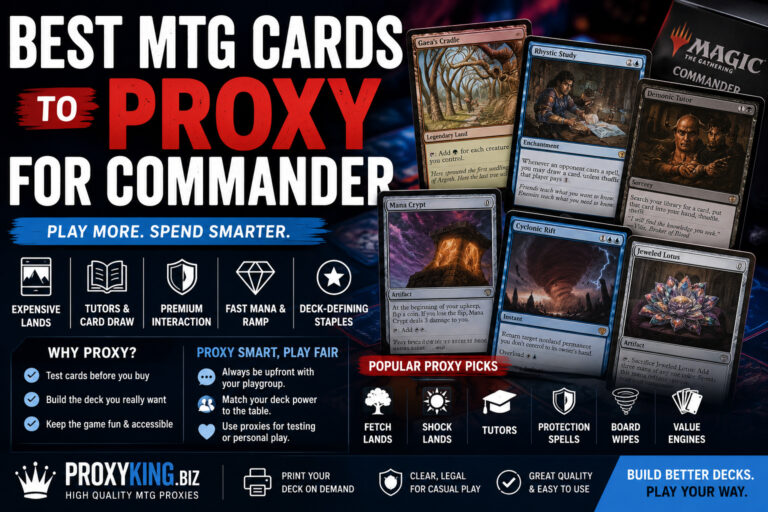
Best MTG Cards To Proxy For Commander

TLDR

The best MTG cards to proxy for Commander are usually expensive staples, mana base upgrades, deck-defining cards and high-power interaction you want to test before buying.

Start with lands, tutors, protection spells and expensive synergy pieces. These cards often change how a deck plays, so proxying them helps you decide whether they are actually worth owning.

Avoid proxying banned cards for normal Commander unless your playgroup specifically allows them. Also avoid turning a casual deck into a high-power deck without telling the table.

For clean Commander proxies, you can use ProxyKing.biz to print MTG proxies for casual decks, testing and personal play.

Commander is the format where one card can cost more than the rest of the deck. Sometimes that card is a Reserved List land. Sometimes it is a tutor. Sometimes it is a protection spell that keeps your combo alive. And sometimes it is just Rhystic Study sitting there, asking the most annoying question in Magic.

That is why proxies make sense for a lot of Commander players. The best MTG cards to proxy for Commander are the cards that help you test a deck, smooth out a mana base or play the version of the deck you actually want without buying every expensive staple first.

This does not mean every deck needs every staple. It also does not mean every table wants to play against fully powered proxy piles. The best approach is simple: proxy with a purpose, tell your group and match the power level of the table.

Start With Your Mana Base

Mana bases are usually the best place to start proxying.

That is not the most exciting answer, but it is usually the correct one. A better mana base lets the deck function. You cast your spells on time. You keep more opening hands. You spend less of the game staring at three lands that somehow produce none of the colors you need.

For two-color and three-color decks, the best mana base proxies often include:

Fetch lands
Shock lands
Triomes
Battlebond lands
Pain lands
Filter lands
Check lands
Slow lands
Surveil lands
Boseiju, Who Endures
Otawara, Soaring City
Cavern of Souls
Ancient Tomb
City of Brass
Mana Confluence
Reflecting Pool
Gemstone Caverns
Phyrexian Tower
Urborg, Tomb of Yawgmoth
Yavimaya, Cradle of Growth

Fetch lands are some of the most useful Commander proxies because they improve fixing, fill the graveyard and support landfall, revolt, delirium and shuffle effects. If you play green landfall, graveyard decks, five-color decks or three-color decks with demanding mana, fetch lands are a good first test.

Shock lands and triomes are also useful proxies because they work well with fetch lands. If you are building a deck and not sure whether the expensive land package is worth it, proxy the lands first. You will know quickly.

For casual Commander, you do not need every fetch and shock. But if the deck keeps losing to its own mana, mana base proxies are better than adding one more splashy mythic.

Proxy Reserved List Lands Carefully

Reserved List lands are some of the most common Commander proxies because the real cards can be expensive, scarce and unrealistic for many players.

The big names include:

Gaea’s Cradle
Serra’s Sanctum
The Tabernacle at Pendrell Vale
Underground Sea
Tropical Island
Tundra
Volcanic Island
Bayou
Savannah
Scrubland
Badlands
Taiga
Plateau

The original dual lands are simple but powerful. They have basic land types, enter untapped and work with fetch lands. For optimized multicolor Commander decks, they are clean upgrades.

Gaea’s Cradle is a different story. It is not just a mana fixer. It can produce absurd amounts of green mana in creature-heavy decks. If you proxy Cradle into Elves, tokens, Selesnya creatures or any deck that floods the board, the deck may jump in power fast.

Serra’s Sanctum does the same kind of thing for enchantress decks. The Tabernacle at Pendrell Vale can make creature decks miserable if the table is not ready for that play pattern.

So yes, Reserved List lands are some of the best MTG cards to proxy for Commander. But they are also some of the easiest cards to underestimate. Proxy them when they match the table, not just because they are expensive.

Fast Mana And High-Power Artifacts

Fast mana is one of the biggest power-level signals in Commander.

Some fast mana cards are legal and common in high-power tables. Others are banned in Commander and should not be used in normal games unless your group is house-ruling them.

Good legal proxy candidates include:

Mox Diamond
Chrome Mox
Mana Vault
Grim Monolith
Lion’s Eye Diamond
Lotus Petal
Mox Amber
Mox Opal
Jeweled Amulet
Ancient Tomb

Mox Diamond and Chrome Mox are strong because they let you get ahead early. They are best in decks that can use the tempo advantage or recover from the card disadvantage.

Mana Vault and Grim Monolith are good proxies for artifact decks, big mana decks and combo decks. They are not subtle cards. If a deck uses them well, it probably moves toward a higher-power table.

Lion’s Eye Diamond is a more specific proxy. It belongs in graveyard, combo or cEDH-style decks that can actually use the discard. It is not a normal casual upgrade.

Do not treat fast mana as a harmless budget fix. Fast mana changes games. If one player starts on land, Sol Ring, Mana Vault while the rest of the table is playing tapped lands, the game can tilt early.

Also, check legality before proxying famous banned cards. Mana Crypt and Jeweled Lotus are not normal Commander proxy targets anymore unless your group has explicitly agreed to use them.

Tutors Worth Proxying

Tutors are good proxy targets because they show whether your deck needs consistency or whether the tutor just makes games repetitive.

The best tutor proxies include:

Demonic Tutor
Vampiric Tutor
Imperial Seal
Enlightened Tutor
Mystical Tutor
Worldly Tutor
Gamble
Crop Rotation
Finale of Devastation
Natural Order
Survival of the Fittest
Eladamri’s Call
Intuition

Demonic Tutor is the cleanest example. It finds anything for two mana. That is powerful in almost any black deck. It is also the kind of card that can push a deck from casual to tuned very quickly.

Vampiric Tutor and Imperial Seal are even more efficient, but they put the card on top of the library. They are strongest when the deck can draw immediately or when the setup is worth waiting for.

Enlightened Tutor is excellent in artifact and enchantment decks. Mystical Tutor is strong in spell decks, combo decks and control shells. Worldly Tutor fits creature-combo and toolbox decks.

Crop Rotation looks narrow, but it can find some of the strongest lands in Commander. In the right deck, it is not just ramp or fixing. It is a one-mana way to find Gaea’s Cradle, Field of the Dead, Bojuka Bog, Glacial Chasm or a combo land.

Proxy tutors when you want to test deck consistency. But be honest about what they do. A deck with several cheap tutors will usually feel much stronger than the same deck with more draw spells and redundancy.

Free And Premium Interaction

Interaction is one of the best places to proxy because it helps decks keep up with faster tables.

Good interaction proxies include:

Force of Will
Force of Negation
Fierce Guardianship
Deflecting Swat
Deadly Rollick
Flawless Maneuver
Teferi’s Protection
Cyclonic Rift
Mana Drain
Orcish Bowmasters
The One Ring
Pact of Negation
Mental Misstep, for cEDH tables

Free spells are strong because they let you tap out while still protecting yourself. Fierce Guardianship can protect a win attempt or stop someone else’s. Deflecting Swat can save a commander, redirect removal or steal a game-ending spell. Force of Will and Force of Negation help stop fast combo.

These are good proxy targets because they are often expensive and they change how a deck plays. A blue deck with Force of Will behaves differently from a blue deck that must leave mana open every turn.

Teferi’s Protection is a different kind of premium spell. It can save you from removal, combat damage, board wipes and bad decisions. Sometimes all four.

Cyclonic Rift is one of the classic Commander staples. It is powerful because it can be a cheap bounce spell early or a one-sided reset later. Proxy it if you want to test whether your deck needs that kind of reset. Also understand that some casual tables are tired of seeing it.

Card Draw And Value Engines

Card draw engines are good Commander proxy targets because they determine whether a deck can keep playing after the first wave of spells.

Strong proxy candidates include:

Rhystic Study
Mystic Remora
Esper Sentinel
Smothering Tithe
Necropotence
Sylvan Library
The One Ring
Consecrated Sphinx
The Great Henge
Bolas’s Citadel
Black Market Connections

Rhystic Study is a classic example. It is not complicated, but it puts constant pressure on the table. People either pay the tax or let you draw. Either way, the card changes the game.

Mystic Remora is cheaper in mana but more temporary. It is strongest in faster metas where noncreature spells are flying around early.

Smothering Tithe is one of the best white value engines. It can fund huge turns, fix mana and make Treasure at a silly rate if opponents draw a lot of cards.

Necropotence is worth proxying if you play black and want to understand what real card advantage feels like. It rewards careful play, but the ceiling is very high.

The One Ring is a strong proxy target because it fits into many decks and gives colorless card draw. It is also the sort of card you should test before buying because not every deck wants the burden counters and tempo pattern.

Value engines are not always flashy. But they often decide who gets to keep playing real Magic after turn six.

Deck-Defining Combo And Synergy Cards

Some cards are worth proxying because they define an entire deck.

These include:

Food Chain
Underworld Breach
Ad Nauseam
Survival of the Fittest
Doubling Season
Anointed Procession
Parallel Lives
Mondrak, Glory Dominus
Yawgmoth, Thran Physician
The Chain Veil
Earthcraft
Dramatic Reversal
Isochron Scepter
Painter’s Servant
Grindstone
Cloudstone Curio

These are not just “good cards.” They often tell the deck what it is.

Food Chain makes sense in decks built around exile loops and cast-from-exile creatures. Underworld Breach belongs in graveyard combo and storm shells. Ad Nauseam belongs in low-curve decks that can turn cards into a win.

Doubling Season, Anointed Procession, Parallel Lives and Mondrak are great proxies for token decks. They can also become expensive quickly if you are trying to build several token decks at once.

Cloudstone Curio is a good proxy for creature-combo and artifact-combo decks. The Chain Veil belongs in planeswalker-heavy decks and combo shells.

Proxy these cards before buying because they are not universally good. They are powerful when the deck is built around them. In the wrong list, they can sit there doing very little while everyone judges your financial choices.

Expensive Tribal And Theme Staples

Commander is full of theme decks that get much better with one or two expensive cards.

Good theme-based proxy targets include:

Edgar Markov
Sliver Queen
The Ur-Dragon
Kaalia of the Vast
Rin and Seri, Inseparable
Elesh Norn, Grand Cenobite
Avacyn, Angel of Hope
Razaketh, the Foulblooded
Vorinclex, Voice of Hunger
Craterhoof Behemoth
Akroma’s Memorial
Kindred Discovery
Roaming Throne
Cavern of Souls
Vanquisher’s Banner

Some of these are commanders. Some are finishers. Some are support cards that make a tribe run better.

Cavern of Souls is one of the best tribal land proxies because it fixes mana and protects key creatures from counterspells. Kindred Discovery can bury the table in cards if your creature type attacks or enters often. Roaming Throne is a strong role-player in many typal decks.

Craterhoof Behemoth is one of the classic green finishers. It is not subtle. If you proxy it into tokens or Elves, you are telling the table the game can end out of nowhere.

Theme staples are good proxies because they help you decide whether the deck’s ceiling is worth pursuing. If the card is fun and the group likes the power level, you can decide later whether to buy it.

Cards To Avoid Proxying First

Not every expensive card should be your first proxy.

Avoid starting with cards that do not fit your deck’s plan. A random Force of Will in a low-blue deck is not helpful. A Gaea’s Cradle in a creature-light deck is a flex, not a plan. A tutor package in a casual deck may make it more consistent but less fun.

Also avoid proxying banned cards for normal Commander. Cards like Dockside Extortionist, Mana Crypt, Jeweled Lotus and Nadu, Winged Wisdom are not normal deck upgrades under the current Commander banned list. Your table can house-rule whatever it wants, but do not treat banned cards as standard recommendations.

Cheap staples are also not always worth proxying. Sol Ring, Arcane Signet, Command Tower, Swords to Plowshares, Counterspell, Beast Within and similar cards are easy to own in most cases. Proxy them if you are building a full test deck, sure. But if you are choosing priority proxies, start with cards that are expensive, hard to find or important to test.

A Simple Proxy Priority List

Here is the order I would use for most Commander decks:

PriorityProxy TypeExamples
1Mana baseFetch lands, shock lands, triomes, Cavern of Souls
2Deck-defining piecesFood Chain, Doubling Season, Survival of the Fittest
3Expensive interactionForce of Will, Fierce Guardianship, Deflecting Swat
4Value enginesRhystic Study, Smothering Tithe, The One Ring
5TutorsDemonic Tutor, Enlightened Tutor, Worldly Tutor
6Reserved List cardsGaea’s Cradle, Serra’s Sanctum, original dual lands
7FinishersCraterhoof Behemoth, Finale of Devastation, Expropriate

That order is not universal, but it works for most players. Fix the mana first. Test the cards that define the deck. Add premium interaction if the table needs it. Then fill in the expensive staples.

Where To Print MTG Proxies For Commander

Once you know which cards you want to test, you can make simple paper proxies at home or order cleaner card-style proxies.

For a more polished option, ProxyKing.biz is a good fit for Commander players who want printed MTG proxies for casual play, deck testing or personal use. Their print service lets you paste in a deck and print cards on demand, which is useful if you are testing a full Commander list rather than one or two cards.

I would use a service like ProxyKing when the deck is mostly settled and you know which proxies will stay in the list. For early testing, paper slips in sleeves are fine. They are not pretty, but they answer the important question: does this card actually make the deck better?

Then, once the list feels right, you can order cleaner proxies for the cards you plan to keep.

How To Proxy Without Causing Table Problems

Commander is social. That means proxies are not just a deckbuilding choice. They are a table conversation.

A few rules help:

Tell people you are using proxies before the game.
Do not pass proxies off as real cards.
Do not trade or sell proxies as real cards.
Avoid unreadable or confusing proxy art.
Keep the card name and rules text clear.
Match the table’s power level.
Do not use proxies as an excuse to pubstomp.

The last point matters most. Proxies are great when they make the game more accessible. They are less great when one player uses them to bring a tuned cEDH-level deck to a relaxed precon table.

A good Commander proxy should make the deck playable, testable or more expressive. It should not make the table regret inviting you.

Final Thoughts

The best MTG cards to proxy for Commander are the cards that let you test the real version of your deck.

Start with mana bases, because lands make everything else work. Then look at deck-defining cards, expensive interaction, value engines, tutors, Reserved List cards and theme staples. Avoid banned cards unless your group has agreed to house rules. And always be clear with your table.

Proxying is at its best when it helps people play better games. It lets you try a Gaea’s Cradle before spending serious money. It lets you see whether Rhystic Study belongs in your blue deck. It lets you test whether your mana base is the problem. Spoiler: it often is.

For clean printed Commander proxies, ProxyKing.biz is a useful place to start.

FAQs

What Are The Best MTG Cards To Proxy For Commander?

The best MTG cards to proxy for Commander are expensive mana base cards, Reserved List lands, tutors, premium interaction, value engines and deck-defining synergy pieces. Fetch lands, Gaea’s Cradle, Rhystic Study, Fierce Guardianship and Doubling Season are good examples.

Should I Proxy Lands First In Commander?

Yes, in most cases. Lands are one of the best proxy categories because they improve consistency without changing the deck’s main theme. Fetch lands, shock lands, triomes and utility lands are great cards to test.

Is It Okay To Proxy Expensive Commander Staples?

It depends on your playgroup. Many casual Commander groups allow proxies, especially for testing or avoiding high card prices. Always tell the table before the game starts.

Should I Proxy Banned Cards In Commander?

Not for normal Commander games. Banned cards should only be used if your group has clearly agreed to a house-rule game. Otherwise, stick to legal cards.

What Commander Cards Should I Not Proxy?

Do not proxy cards that do not fit your deck, cards that make the power level too high for your group or cards that are banned in Commander. Also avoid unreadable proxies with unclear names or text.

Where Can I Print MTG Proxies?

You can print simple proxies at home or use an MTG proxy printing service. For printed Commander proxies, ProxyKing.biz is a useful option.

Open post

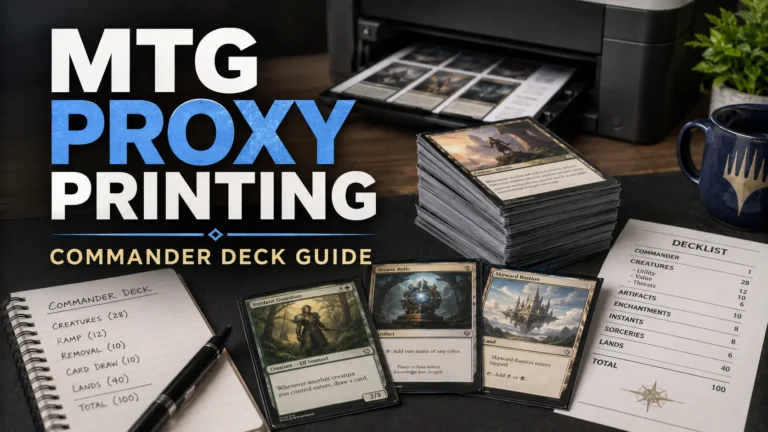
MTG Proxy Printing: How To Print A Commander Deck That Feels Good To Play

TLDR

MTG proxy printing is best when the cards are readable, sleeve-ready and easy to sort into a real deck. For Commander, that usually means printing the whole list at once, choosing clear card versions and avoiding blurry images that slow down gameplay. A service like PrintMTG.com works well when you want to paste or upload a decklist, pick versions and get printed proxies without turning your dining room into a paper cutter station.

Meta Description

MTG proxy printing made simple: learn how to print Commander proxies, choose readable cards and build a sleeve-ready deck for casual play.

Commander has a funny way of turning one idea into 100 tiny decisions.

You start with a commander you’re excited about. Then you need ramp, removal, card draw, lands, utility pieces, win conditions and maybe a few pet cards because this is still supposed to be fun. Before long, the deck exists in your head, your deck builder and three half-finished tabs of card searches. MTG proxy printing helps turn that list into something you can actually shuffle, test and play.

The best proxy cards are not just “cards with pictures on them.” They need to be readable across the table. They need to sit cleanly in sleeves. They need to make game actions smoother, not slower. And if you’re printing a full Commander deck, consistency matters more than one flashy card that looks great by itself.

This guide covers how to think about MTG proxy printing for Commander, Cube and casual Magic: The Gathering play. We’ll look at decklist prep, card readability, image choices, sleeves, card feel and the common mistakes that make proxies annoying at the table.

Why MTG Proxy Printing Works So Well For Commander

Commander is one of the cleanest fits for MTG proxy printing because the format asks for a lot of unique cards. A normal Commander deck is 100 cards including the commander, and most non-basic cards are singletons. That means you are not just printing four copies of ten cards. You are often printing a full deck full of different names, effects and art treatments.

That changes the job.

For Modern or Pioneer testing, you might only need a handful of cards to test a sideboard plan. For Commander, proxies often help you test the whole machine. You can see whether your mana base actually works, whether your draw engines are enough and whether your “cute” seven-mana card is secretly just sitting in your hand while everyone else plays real Magic.

The main benefit is speed. You can go from deck idea to playable stack without slowly collecting every card first. That makes brewing more practical. It also helps you avoid spending money on cards that sounded better in theory than they feel in a real pod.

There’s another benefit too: it makes deck power easier to tune. If your table wants a slower battlecruiser game, you can test lower-pressure cards. If your group wants a sharper deck, you can test stronger interaction and mana. Proxies make the testing phase feel less locked in.

Start With A Clean Decklist

The easiest way to ruin a proxy order is to start with a messy list.

Before printing anything, clean up your decklist. Make sure card names are spelled correctly. Remove maybeboard cards unless you actually want them printed. Check quantities, especially for basic lands. If your list includes set-specific versions, alternate art or special printings, decide whether those versions matter before ordering.

A simple Commander prep checklist looks like this:

  • Confirm the commander
  • Confirm the full 99
  • Separate tokens, emblems and extra cards
  • Remove maybeboard cards
  • Decide how many basic lands you need
  • Pick readable versions over hard-to-parse versions
  • Export or copy the list in a format the printer can understand

This is where a decklist-based site helps. PrintMTG.com is built around uploading or pasting a card list, choosing versions and printing MTG proxy cards on demand. That is a better fit for full-deck proxy printing than manually laying out dozens of card images yourself.

Choose Readable Card Versions First

Alternate art is one of the best parts of Magic, but proxy printing is not the place to choose art only because it looks cool in a thumbnail.

A proxy card has a job. It has to tell everyone what the card is. That includes the name, mana cost, type line, rules text, power and toughness when relevant. If the art treatment makes that harder, pick a simpler version.

This matters most for cards with long rules text, modal cards, double-faced cards and older cards with unusual templating. A stunning full-art version might be great for a binder page, but a clean normal-frame version may be better during a four-player Commander game with three board states, ten dice and someone asking whether your creature has reach.

My usual rule is simple: if you need to squint at the card image on your screen, it probably will not get better after printing.

Good proxy version choices tend to have:

  • Clear card names
  • Strong contrast
  • Easy-to-read rules text
  • Familiar frames
  • Clean color identity cues
  • Art that does not fight the text box

This does not mean every proxy has to look plain. It just means gameplay clarity comes first. The best proxies are the ones people stop noticing after the first few turns because they function like normal game pieces.

Think About The Whole Deck, Not One Card

A lot of players judge proxy quality by looking at one card close up. That makes sense, but it is not the full test.

A Commander deck is a stack of 100 cards. The proxies need to shuffle together, sit in sleeves consistently and feel uniform during play. If half the cards are thick, half are thin and a few have odd cuts or strange finishes, the deck feels off even if each individual card looks decent.

For full-deck MTG proxy printing, consistency is more important than novelty. Matching stock, matching finish and clean trimming make the deck easier to handle. This is also why many players prefer printing the whole deck through one workflow instead of mixing paper slips, home-printed cards and random singles from different sources.

Sleeves help a lot here. Even well-printed proxies should usually be sleeved. Sleeves make the deck easier to shuffle, protect the cards and create a more consistent feel. They also help proxies blend into the play experience rather than becoming the main thing everyone notices.

Home Printing Vs Print-On-Demand Proxies

Home printing works. It is also kind of a chore.

For a few cards, paper slips in front of bulk cards are fine. That method is fast, cheap and easy to change. If you’re testing three swaps before a game night, there’s nothing wrong with it.

The problems show up when you print a full deck. You have to find good images, lay them out, print them, cut them, sleeve them and hope everything is readable. If the cards are slightly different sizes or the ink looks muddy, you feel it every time you shuffle.

Print-on-demand proxy cards make more sense when you want a full Commander deck, Cube package or large batch of playtest cards. You trade a little flexibility for cleaner output and less manual work.

Here’s the practical split:

Use paper slips when you are testing a few cards for one night.

Use home printing when you enjoy the process and do not mind trimming cards yourself.

Use print-on-demand when you want a full deck that is easier to sleeve, shuffle and read.

None of these options is automatically wrong. They just solve different problems.

Don’t Forget Tokens And Extra Game Pieces

Commander decks often need more than the main 100 cards.

Tokens are the big one. If your deck makes Treasures, Clues, Food, Goblins, Zombies, Saprolings or copies of creatures, print the tokens too. You do not need every possible token, but you should have the ones your deck makes all the time.

Also check for:

  • Double-faced helper cards
  • Emblems
  • Copy tokens
  • Initiative or dungeon cards
  • Keyword counters
  • Extra commanders for partner-style decks
  • Reminder cards for complex mechanics

This is not glamorous, but it makes the deck easier to play. Nothing slows down a game like making ten tokens and then representing them with loose dice, upside-down lands and a business card from your wallet.

Common MTG Proxy Printing Mistakes

The most common mistake is printing too early. Brew the deck first, then print it. If you keep changing 20 cards every day, wait until the list settles.

The second mistake is choosing unreadable versions. Some alternate art cards look great online but are harder to read once printed and sleeved.

The third mistake is forgetting lands. Commander mana bases can be a mess. Make sure your land count, color sources and utility lands are actually in the list before printing. It is annoying to receive a deck and realize you forgot Command Tower, Path of Ancestry or half your basics.

The fourth mistake is mixing too many proxy methods in one deck. A couple of paper slips are fine. But if the whole deck is a mix of different paper thicknesses, different finishes and different trim sizes, it starts to feel messy.

The fifth mistake is skipping a final card-by-card review. Before you print, scan the list one more time. Make sure every card belongs. Make sure you did not leave in a placeholder from an earlier version. Make sure the commander is actually included. It sounds obvious until it happens.

A Simple MTG Proxy Printing Workflow

Here’s the cleanest workflow for most Commander players.

Build the deck in your preferred deck builder. Goldfish a few hands. Check your mana curve. Make sure the deck has enough ramp, draw and interaction. Then export the list.

Next, choose your card versions. Favor readable printings for rules-heavy cards. Choose fun art where it does not hurt clarity.

Then add tokens and extra cards. This is the step people forget.

After that, place the proxy order through a decklist-based service like PrintMTG.com. When the cards arrive, sleeve the deck, shuffle it and play a few games before making big changes.

The first version does not have to be final. It just has to be playable. Commander decks get better through reps, not theory alone.

Conclusion

MTG proxy printing is at its best when it helps you play more Magic with less friction. For Commander, that means clean decklists, readable card versions, consistent printing and a sleeve-ready stack that feels good in a real game.

You do not need to overcomplicate it. Build the list. Clean it up. Pick versions people can read. Print the cards in a consistent format. Then play enough games to see what actually works.

That is the whole point. Proxies should get the deck out of your head and onto the table.

FAQs

What Is The Best Keyword For This Article?

The best focus keyword is MTG proxy printing. It matches the main search intent and naturally covers related searches like print MTG proxies, Commander proxies, proxy deck printing and Magic proxy cards.

Is MTG Proxy Printing Best For Full Decks Or Single Cards?

It works for both, but it is especially useful for full Commander decks, Cube lists and larger playtest batches. For one or two quick swaps, paper slips may be enough.

Should I Print Tokens With My Commander Proxies?

Yes, in most cases. If your deck regularly makes tokens, copies or emblems, printing those pieces makes the deck much easier to play.

What Makes A Good MTG Proxy Card?

A good MTG proxy card is readable, sleeve-ready, consistent with the rest of the deck and easy to identify during gameplay. Fancy art is nice, but clarity matters more.

Should I Use Full-Art Cards For Proxies?

Use full-art versions when they are still easy to read. For cards with long text or complex mechanics, a normal-frame version is often better.

Where To Find The Most Affordable Pollywog Prodigy Cards

TLDR

The most affordable Pollywog Prodigy cards are usually the regular Bloomburrow Commander #15 copies, not the Extended Art #50 version. As of April 2026, MTGGoldfish shows the regular tabletop price around $6, while PriceCharting lists the current ungraded market price around $6.44. Card Kingdom is higher at $8.49 for Near Mint, but it is simpler if you care about clear condition grading and reliable stock.

Introduction

Pollywog Prodigy is one of those small blue creatures that reads cute until it starts drawing three cards because your opponents keep casting cheap noncreature spells. A 1/3 Frog Wizard with evolve does not look scary at first. Then somebody casts a mana rock, a tutor, a protection spell, or a cantrip, and suddenly the frog is doing a very solid Rhystic Study impression with little webbed feet.

That is why affordable Pollywog Prodigy cards can disappear fast when Commander players remember the card exists. It fits +1/+1 counter decks, creature-heavy decks, blue tempo shells, Frog decks, and casual tables where opponents cast a lot of noncreature spells without thinking about it.

The good news: you usually do not need the fancy version. The regular Bloomburrow Commander #15 printing is the copy to target if price matters. The Extended Art version is roughly twice as expensive, and unless you specifically want the showcase look, it does not do anything different in your deck. MTGGoldfish lists the regular #15 copy at about $6 and the Extended Art #50 copy around $11 as of this check.

Best Place To Start: Use mtg.cards Before You Buy

Before you start hunting listings, put Pollywog Prodigy into the deck you actually plan to play. The mtg.cards MTG Deck Builder is a good place to stage the list, check your curve, and see whether the card belongs in the main deck or maybe-board.

That matters because Pollywog Prodigy is not a card every blue deck needs. It is better when your deck can grow its power, protect it, or naturally trigger evolve. If your deck is mostly spells and has very few creatures entering with higher power or toughness, the card is still playable, but it may not be worth chasing at a higher price.

A simple rule: if Pollywog Prodigy will draw two or more cards in most games, it is probably worth a $5 to $7 price tag. If it is just a cute two-drop that dies before doing anything, spend that money on lands, protection, or another proven draw engine.

Buy The Regular BLC #15 Version First

The regular Bloomburrow Commander #15 printing is the budget copy. It has the same game text, same mana cost, and same deck function as the Extended Art version. It is simply less flashy.

That is what you want when you are buying for play.

Card Kingdom identifies Pollywog Prodigy as a rare Creature, Frog Wizard, collector number 0015, with evolve and the card-draw trigger tied to opponents casting noncreature spells with mana value less than its power. Card Kingdom had Near Mint copies available at $8.49 at the time checked, with lower-condition prices listed but out of stock.

MTGGoldfish was lower, listing the regular #15 tabletop price at $6.00 and the Extended Art version at $11. PriceCharting showed recent TCGplayer sales in March ranging roughly from $5.00 to $6.30, with some eBay sales higher.

That gives us a practical buying range:

VersionGood Target PriceNotes
Regular BLC #15$5 to $7Best choice for gameplay
Lightly Played RegularUnder $5.50Great if sleeved
Extended Art #50$10 to $12Only worth it if you want the look
Card Kingdom NMAround $8.50Higher price, simpler condition confidence

Prices move, but the pattern is clear. Regular first. Extended Art only if you care about collecting.

Check TCGplayer For The Lowest Single-Copy Price

TCGplayer is usually the first stop for the cheapest Pollywog Prodigy cards because it has many sellers competing at once. That can push the raw card price down below larger store pricing.

The catch is shipping.

A $5.25 copy with $1.49 shipping is not cheaper than a $6.00 copy with free shipping. This sounds obvious, but MTG singles shopping is basically a tiny math test with a shopping cart attached.

When comparing TCGplayer listings, check:

  • Card version: Regular #15, not Extended Art #50
  • Condition: Near Mint or Lightly Played
  • Shipping: Free, low-cost, or bundled with other cards
  • Seller volume: Enough feedback to feel safe
  • Cart optimizer: Useful, but double-check the final total

For one copy, the best deal is often whichever seller has the lowest combined card-plus-shipping total. For multiple cards, TCGplayer gets better because you can bundle Pollywog Prodigy with other Commander upgrades and spread shipping across the whole order.

Use eBay For Auctions, Playsets, And Odd Deals

eBay can beat TCGplayer, but it takes more patience. The best eBay deals usually come from auctions, combined shipping, or sellers who list a card slightly below market to move inventory.

The problem is that eBay also has plenty of listings above market. PriceCharting shows completed Pollywog Prodigy #15 sales where TCGplayer sales were often in the $5 to $6 range in March 2026, while some eBay results were $7.00, $7.99, or higher.

That does not mean eBay is bad. It just means you should use completed sales as your reality check.

A good eBay strategy:

  • Search for “Pollywog Prodigy BLC 15”
  • Sort by lowest total price with shipping
  • Check sold listings before buying
  • Avoid paying Extended Art prices for the regular version
  • Watch for sellers with strong feedback and clear photos

If you are buying one copy for Commander, eBay is worth checking. If you need the card quickly, TCGplayer or Card Kingdom is usually simpler.

Card Kingdom Costs More, But It Is Cleaner

Card Kingdom is rarely the cheapest option for a hot Commander single. But it has a place.

If you care about clear grading, easy checkout, and reliable stock, Card Kingdom can be worth paying a little more. At the time checked, Card Kingdom had 8 Near Mint regular Pollywog Prodigy copies available at $8.49. The lower condition tiers were listed at $6.79, $5.94, and $4.25, but those were out of stock.

That tells you two useful things.

First, the true budget copies tend to disappear. If Excellent or Very Good copies come back in stock, they may be the best buy for a sleeved Commander deck.

Second, Near Mint from a large retailer costs extra because you are paying for convenience and condition confidence. That is not always the wrong choice. It is just not the cheapest choice.

Do Not Overpay For Extended Art Unless You Want It

The Extended Art Pollywog Prodigy is the trap for budget buyers.

It looks nicer. That is the whole argument. If that matters to you, great. Commander decks are personal, and some players like their favorite cards to look sharp.

But if the goal is the most affordable Pollywog Prodigy cards, Extended Art is the wrong target. MTGGoldfish lists the regular #15 version at $6.00 and the Extended Art #50 version at $11. Scryfall’s search result also showed the regular version around the mid-$5 range and the Extended Art version around the low-$11 range when checked.

That price gap buys you another playable card. Maybe two.

For budget Commander, that matters. A deck gets stronger from 99 good decisions, not one prettier Frog Wizard.

Know Why Pollywog Prodigy Is Holding Value

Pollywog Prodigy is not expensive just because it is cute. It has real Commander appeal.

The card has evolve, so it can grow as your creatures enter. Then it draws cards when opponents cast noncreature spells with mana value less than its power. That means it gets better in decks that naturally put counters on creatures, play higher-powered creatures, copy creatures, or make Pollywog Prodigy bigger with anthems and equipment.

EDHREC also shows Pollywog Prodigy appearing in a large number of Commander decklists, with especially strong inclusion rates in commanders like Clement, the Worrywort, Zinnia, Valley’s Voice, Glarb, Calamity’s Augur, and Grolnok, the Omnivore.

That demand explains why the card may not crash to bulk-rare pricing. It is a two-mana card advantage creature in blue, and Commander players love that sentence.

When To Buy Now Versus Wait

Buy now if you need Pollywog Prodigy for an active deck and you can find a regular copy around $5 to $6 before shipping. That is a fair price based on current visible market data.

Wait if the cheapest copy you can find is closer to $8 to $10 and you do not need it right away. At that point, you are creeping into Card Kingdom Near Mint territory or paying too much for marketplace shipping.

I would not buy the Extended Art copy as a budget move. I would only buy it if the card is a pet card, a deck centerpiece, or you just like the art treatment enough to pay the premium.

Here is the simplest decision rule:

Your SituationBest Move
You need one playable copyBuy regular #15 around $5 to $7
You want the lowest possible priceWatch TCGplayer and eBay sold listings
You care about clean conditionUse Card Kingdom or a high-feedback seller
You want the fancy versionBuy Extended Art #50, but accept the premium
You are unsure it fits your deckTest it in mtg.cards first

Final Recommendation

The most affordable Pollywog Prodigy cards are regular Bloomburrow Commander #15 copies from TCGplayer-style marketplace sellers, especially when shipping is low or bundled. eBay can beat that price sometimes, but you have to compare sold listings and shipping. Card Kingdom is the easier, cleaner buy, but usually not the cheapest.

Use the PrintMTG Card Maker before buying if you are still tuning the list. Pollywog Prodigy is at its best when your deck can grow it and protect it. If your deck does that, a regular copy around $6 is a reasonable pickup. If your deck does not, the most affordable move might be skipping the frog for now.

And yes, “skip the frog” feels wrong. But sometimes that is how budget deckbuilding works.

FAQs

What Is The Cheapest Pollywog Prodigy Version?

The cheapest version is usually the regular Bloomburrow Commander #15 printing. The Extended Art #50 version typically costs more and is mainly a cosmetic upgrade.

Is Pollywog Prodigy Worth Buying For Commander?

Yes, if your deck can grow its power or naturally trigger evolve. It is especially good in +1/+1 counter decks, creature-heavy blue decks, Frog decks, and Commander pods where opponents cast lots of cheap noncreature spells.

Should I Buy Near Mint Or Lightly Played?

Lightly Played is fine for most Commander players using sleeves. Near Mint is better if you care about collection condition, but it often costs more.

Is Card Kingdom The Cheapest Place To Buy Pollywog Prodigy?

Usually no. Card Kingdom is often more expensive than marketplace listings, but it can be worth using for reliable grading, simple checkout, and predictable stock.

Is The Extended Art Pollywog Prodigy Worth It?

Only if you care about the look. For gameplay, the regular version does the exact same thing and is usually much cheaper.

Bar Stickers And Decals: The Easy Way To Make A Home Bar, Pub, Or Cocktail Station Look Legit

TLDR

Bar stickers and decals can be used for home bars, commercial bars, wedding cocktail stations, glassware, mirrors, fridges, coolers, menus, windows, and wall decor.

Use small stickers for bottles, glassware, packaging, and giveaways. Use transfer decals for clean lettering on mirrors, windows, walls, and bar carts. Use large wall decals when you want the whole space to feel like an actual bar instead of “a shelf with bottles and ambition.”

For custom bar names, window lettering, mirror decals, and clean one-color bar graphics, CustomStickers.com transfer stickers are a strong fit because they’re made for cut vinyl designs on walls, windows, cars, water bottles, and other smooth surfaces.

Bar Stickers And Decals Are Doing More Than Decorating

Bar stickers and decals are one of those details that can make a space feel finished fast.

A home bar without signage can look like a nice cabinet. Add a clean custom decal that says “Dunn’s Pub,” “The Basement Bar,” “Cocktails Served Here,” or “Open When We Feel Like It,” and suddenly the area has a personality. It’s still the same room, sure. But now it has a bit.

For commercial bars, decals do more practical work. They can mark windows, label taps, promote specials, add QR codes, decorate restrooms, brand glassware, point people to the patio, or make a blank wall less sad. For weddings and parties, bar decals can turn a folding table into a cocktail station that looks intentional in photos.

The trick is picking the right type. Not every sticker belongs on a wall. Not every decal belongs on a glass. And not every “bar sign” needs to look like it came from a chain restaurant that sells loaded potato skins with deep emotional confidence.

1. Custom Name Bar Decals

This is the classic home bar move.

A custom name bar decal usually includes a name, short phrase, year, family name, pub name, or cocktail-themed graphic. These are often used on walls, mirrors, glass panels, bar backs, acrylic signs, and sometimes doors.

Popular examples include:

  • “Ryan’s Bar”
  • “The Dunn Pub”
  • “Established 2026”
  • “The Whiskey Room”
  • “The Cocktail Corner”
  • “Dad’s Garage Bar”
  • “Open Late”
  • “Last Call Is A Suggestion”
  • “Welcome To The Home Bar”

Custom name decals work best when the design is simple. A name, a small icon, and maybe a year. That’s enough. You do not need a full origin story, three fonts, a barrel illustration, a martini glass, a beer mug, a neon effect, and your family crest.

Unless your family crest is a tiny raccoon holding a martini. In that case, maybe.

For a polished look, transfer vinyl is usually better than a printed rectangle. The lettering applies directly to the surface, so the wall, mirror, or glass shows through. It looks more like signage and less like a sticker slapped onto a wall.

2. Wall Decals For Home Bars And Man Caves

Wall decals are great when the bar area needs a focal point.

A wall decal can add a quote, cocktail illustration, whiskey barrel graphic, beer mug, wine glass, neon-style phrase, or custom pub name. These are common in basement bars, home theaters, game rooms, garages, patios, rec rooms, and “I turned this corner of the house into a bar and now everyone has opinions” spaces.

Good wall decal ideas include:

  • Cocktail glass line art
  • Whiskey and ice graphics
  • “Cheers” lettering
  • “Home Bar”
  • “Pub Open”
  • Beer mug silhouettes
  • Retro bar lettering
  • Vintage saloon-style names
  • Minimal drink icons
  • Coffee bar decals for kitchen bars

Wall decals work best on smooth, clean walls. Textured walls can be annoying. Not impossible. Just annoying in the same way glitter is annoying: technically manageable, spiritually exhausting.

Before applying a wall decal, clean the wall and let it dry. If the wall was recently painted, wait before applying vinyl. Fresh paint can still be curing, and vinyl adhesive may not behave the way you want.

3. Mirror And Glass Bar Decals

Mirror decals might be the most underrated bar sticker category.

A decal on a mirror behind the bar can look surprisingly professional. It gives that old-school pub sign feel without needing a heavy framed sign. The same idea works on glass cabinet doors, bar carts, windows, acrylic signs, and display cases.

Good mirror and glass decal ideas:

  • Custom bar name
  • Cocktail menu title
  • “Open Bar”
  • “Cheers”
  • Signature drink names
  • Wedding couple names
  • Whiskey club name
  • Beer club logo
  • Social handle
  • Bar hours
  • Small decorative corner graphics

For mirrors and glass, one-color transfer decals are usually the cleanest choice. White vinyl looks great on dark mirrors, tinted windows, and darker backgrounds. Black vinyl works well on light walls, clear glass backed by pale surfaces, or acrylic signs.

Clear printed stickers can also work, but only if the design is built for transparency. If the sticker has light colors and no white ink behind them, the design may fade into the background like it just heard bad news.

4. Bar Window Stickers For Commercial Spaces

Bar window decals are useful for real bars, restaurants, breweries, bottle shops, coffee bars, and event venues.

They can show:

  • Logo
  • Hours
  • Happy hour info
  • Patio entrance
  • QR menu code
  • “Now Open”
  • “Live Music”
  • “Private Event”
  • “Order Here”
  • “Pick Up”
  • Age restriction notices
  • Social media handles

For business windows, readability matters more than cleverness. The decal has to be easy to read from the sidewalk, parking lot, or door. Tiny script lettering might look classy on a screen, but if nobody can read it through glare, it’s just decorative fog.

Use strong contrast. White vinyl often works well on tinted glass. If the window gets direct sun, ask about UV-resistant material or laminate. A window decal should not give up after one summer like it joined a gym in January.

5. Bar Stickers For Bottles, Cans, And Glassware

Small bar stickers are useful when the surface is smaller and more handled.

Use them for:

  • Bottle labels
  • Cocktail kits
  • Party favors
  • Mini liquor bottles
  • Canned cocktails
  • Beer flights
  • Glassware
  • Growlers
  • Mason jars
  • Wedding favors
  • Event drink tags
  • Custom coasters
  • Bar merch

For bottles and glassware, waterproof vinyl or laminated labels are usually better than paper. Paper labels can work for dry, indoor, short-term use, but condensation is rude. It ruins things without asking.

If the sticker goes on something chilled, wet, or handled often, choose a water-resistant material. For commercial bottled products, labels also need to follow any relevant product and alcohol labeling rules. That’s not the fun part, but it is the part that prevents future headaches.

For party favors, keep it simpler. A small custom sticker with the event name, date, and one graphic can make bottles, cups, or treat bags look coordinated without turning the project into a design hostage situation.

6. Bar Fridge, Cooler, And Kegerator Stickers

A bar fridge is basically a sticker canvas with snacks inside.

Fridge, cooler, and kegerator stickers are great for:

  • Brewery logos
  • Funny drinking quotes
  • Tap labels
  • Club stickers
  • Home bar branding
  • Event stickers
  • Band stickers
  • Retro beer designs
  • Custom sports bar decals

This is where durable vinyl matters. Coolers get dragged around. Fridges get wiped down. Kegerators collect fingerprints, splashes, condensation, and the occasional tragic beer foam incident.

Use vinyl stickers with laminate if you want them to last. Matte looks clean. Gloss pops more. Holographic can work if your bar theme is “party goblin with disposable income.”

No judgment. That’s a valid theme.

7. Wedding And Event Bar Decals

Wedding bar decals have become their own little category.

You’ll see decals on acrylic signs, mirrors, bar fronts, cocktail menus, welcome boards, and photo backdrops. They usually include the couple’s names, wedding date, signature drinks, or a short phrase like “Drinks On Us” or “Let’s Toast.”

Good event bar decal ideas:

  • “Open Bar”
  • “Signature Cocktails”
  • “His & Hers Drinks”
  • “Let’s Toast”
  • “Cheers To Love”
  • Custom names and date
  • Cocktail illustrations
  • Menu labels
  • Bar-front lettering

For events, decals are useful because they look custom without needing a permanent sign. You can apply them to acrylic, mirror, wood-look boards, glass, or smooth panels.

The main thing is timing. Do not test your decal application 20 minutes before guests arrive while someone is asking where the ice went. Apply it ahead of time if possible. Future you deserves that mercy.

8. Sticker Packs For Bar Decor

Not every bar sticker needs to be custom.

Sticker packs can give a bar area a more casual, collected feel. Think brewery stickers on a fridge, vintage liquor label stickers on a cabinet, band stickers on a cooler, or retro cocktail stickers on a bar cart.

This works especially well for:

  • Garage bars
  • Dive bar-inspired rooms
  • Kegerators
  • Coolers
  • Bar carts
  • Toolboxes
  • Outdoor patios
  • Brewery-themed spaces
  • College-style home bars

The danger is overdoing it. Sticker bombing can look great when it’s intentional. It can also look like a storage bin exploded.

A good rule: cover one object, not every object. A sticker-covered fridge is fun. A sticker-covered fridge, wall, table, mirror, ceiling fan, and dog bowl is a cry for help.

9. Coffee Bar Stickers And Decals

Not all bar stickers are alcohol-related.

Coffee bars, tea stations, smoothie counters, soda bars, and juice bars also use stickers and decals. These can be decorative or functional.

Use coffee bar decals for:

  • Syrup labels
  • Coffee station signs
  • Cup labels
  • Menu decals
  • Jar labels
  • “Coffee Bar” wall lettering
  • Milk, cream, sugar, and decaf labels
  • Cafe window decals

This is one of the best places to use clean typography. Labels should be easy to read. A syrup bottle that says “Vanilla” should not require detective work.

For jars and bottles, use waterproof labels if the surface will be handled or wiped. For walls, transfer vinyl lettering usually looks cleaner.

Bar Stickers Vs. Bar Decals

The difference is simple enough.

A sticker is usually a printed adhesive piece. Peel it off the backing and stick it on something.

A decal, especially a transfer decal, often uses transfer tape to apply separate vinyl letters or shapes in the correct position. You peel away the backing, press the design onto the surface, rub it down, then remove the transfer tape.

Use stickers for:

  • Bottles
  • Cans
  • Glassware
  • Coolers
  • Fridges
  • Giveaways
  • Packaging
  • Sticker packs
  • Event favors

Use decals for:

  • Walls
  • Mirrors
  • Windows
  • Doors
  • Bar carts
  • Acrylic signs
  • Storefronts
  • Large lettering
  • Custom names
  • One-color logos

A sticker is great for artwork. A decal is great for signage.

That’s the whole tiny sermon.

What Material Should Bar Stickers And Decals Be?

For most bar stickers and decals, vinyl is the safest pick.

Bars are not gentle places. There is condensation, cleaning spray, fingerprints, splashes, sunlight, ice buckets, glassware, and one person who insists on setting wet cups everywhere like it’s their job.

Use this material guide:

Use CaseBest Material
Wall letteringCut vinyl transfer decal
Mirror decalWhite or black transfer vinyl
Window hours or logoOutdoor-rated vinyl
Bottle labelsWaterproof vinyl or laminated label
Glassware stickersWaterproof vinyl
Cooler stickersLaminated vinyl
Bar fridge stickersLaminated vinyl
One-night event signsRemovable vinyl or printed decals
Long-term commercial signageUV-resistant outdoor vinyl
Paper favor labelsPaper or vinyl, depending on use

If the sticker may get wet, rubbed, cleaned, or handled, do not use basic paper. Paper has its place. That place is not usually next to a sweating cocktail glass.

Design Tips For Bar Stickers And Decals

A bar decal should be readable first and clever second.

For wall and window decals, use fewer words and bigger letters. For bottles and glassware, keep the label clean. For mirrors, use contrast. For clear acrylic, test the design against the actual background.

Practical design rules:

  • Use high contrast.
  • Keep text large enough to read.
  • Avoid too many fonts.
  • Use simple icons.
  • Leave breathing room.
  • Match the mood of the bar.
  • Keep tiny details away from cut edges.
  • Use vector files for lettering when possible.
  • Ask for a proof before printing custom work.

And please, for the love of every bartender who has ever cleaned syrup off a counter, do not make a tiny QR code on a curved bottle label and assume it will scan. Test it first.

Best Places To Buy Bar Stickers And Decals

Here’s the quick shopping map.

CustomStickers.com

Best for custom transfer stickers, cut vinyl decals, bar names, wall lettering, mirror decals, window graphics, and one-color designs.

Use this when you have your own design or want a custom name/logo decal.

Etsy

Best for personalized home bar decals, pub wall stickers, wedding bar decals, cocktail station signs, and handmade-style bar decor.

Use this when you want lots of ready-made design options.

Zazzle

Best for bar wall decals and broad decor options in different styles and sizes.

Use this when you want to browse many designs quickly.

Amazon

Best for fast bar wall decals, basic cocktail wall stickers, and inexpensive ready-made decor.

Use this when speed matters more than originality.

Specialty Wall Decal Shops

Best for large vinyl murals, cocktail wall art, wedding bar decals, and custom wall graphics.

Use this when the decal is larger or more decorative.

Local Sign Shops

Best for commercial bar windows, storefront lettering, exterior decals, large wall graphics, and complicated installations.

Use this when the decal needs to look professional in a public business.

The Quick Pick Guide

Choose a custom name decal if you want the bar to feel personal.

Choose a transfer decal if you want clean lettering on a mirror, wall, or window.

Choose waterproof stickers for bottles, cans, glassware, and coolers.

Choose wall decals for large home bar decor.

Choose window decals for commercial hours, logos, and promotions.

Choose sticker packs for a casual dive-bar, brewery, or garage-bar feel.

Choose removable decals for weddings, parties, rentals, and short-term events.

Choose a local sign shop if the decal is large, expensive, public-facing, or painful to redo.

Common Mistakes To Avoid

The first mistake is buying the wrong type of decal. A tiny paper sticker is not a wall sign. A wall decal is not a bottle label. A transfer decal is not the best choice for full-color cocktail artwork.

The second mistake is ignoring the surface. Smooth glass, mirror, acrylic, metal, and painted walls are usually easier. Textured walls, dusty wood, brick, rough plastic, and greasy surfaces are trouble.

The third mistake is making the design too busy. Bar decor already has bottles, glassware, menus, lighting, signs, and shelves. The decal does not need to scream over all of it.

The fourth mistake is forgetting cleaning. Commercial bars and home bars both get wiped down. Use material that can handle it.

The fifth mistake is applying decals in a rush. Decals want a clean surface, steady placement, and patience. They do not want four people giving advice while one person holds a squeegee like a weapon.

Final Answer

Bar stickers and decals are one of the easiest ways to make a home bar, commercial bar, wedding bar, or cocktail station feel finished.

Use transfer decals for clean wall, mirror, window, and bar name graphics. Use waterproof stickers for bottles, glassware, coolers, fridges, and party favors. Use larger wall decals when you want a focal point. Use sticker packs when you want that casual collected bar look.

The best choice depends on the surface, size, and vibe. A home pub name belongs on a clean transfer decal. A beer fridge can handle sticker chaos. A wedding bar deserves something removable and photo-friendly. A commercial window needs readable vinyl that can survive the weather.

Tiny sticker. Big bar energy.

FAQs

What Are Bar Stickers And Decals Used For?

Bar stickers and decals are used for home bar names, wall decor, mirrors, windows, glassware, bottles, coolers, fridges, cocktail stations, wedding bars, menu signs, and business branding.

What Is The Difference Between A Bar Sticker And A Bar Decal?

A sticker is usually a printed peel-and-stick piece. A decal, especially a transfer decal, often uses transfer tape to apply separate vinyl letters or shapes cleanly to walls, windows, mirrors, or glass.

What Kind Of Decal Is Best For A Home Bar Wall?

A cut vinyl transfer decal is usually best for a custom home bar name, pub sign, or wall quote. It gives a clean painted-on look without a visible sticker background.

Can I Put Bar Decals On A Mirror?

Yes. Mirror decals work well, especially in white or black transfer vinyl. Clean the mirror first and apply the decal slowly to avoid bubbles.

Are Bar Stickers Waterproof?

Some are. Vinyl and laminated stickers are better for bottles, glassware, coolers, and fridges. Paper stickers are better for dry, short-term use.

Can I Use Bar Decals For A Wedding Or Party?

Yes. Bar decals are popular for wedding cocktail stations, acrylic signs, mirrors, welcome boards, and bar fronts. Removable or event-friendly vinyl is usually best for temporary setups.

MTG Full Art Lands: Why Players Love Them So Much

MTG full art lands should be the easiest cards in the game to ignore. They are just basics. They tap for one mana. They are not flashy combo pieces. They are not the commander. And yet players will spend a ridiculous amount of time choosing them, matching them, swapping them, and defending those choices like they are life philosophy.

I get it. MTG full art lands do more visual work than almost any other card type in a deck. You see them constantly. They define the table space in front of you. They help set the mood of the whole list. And because you run so many of them, they are one of the clearest ways to make a deck feel like yours.

How MTG Full Art Lands Went From Novelty To Staple

Full art lands did not start as the default expectation they feel like now. At first, they were a novelty. A cool little experiment. A thing that made players stop and stare because the art took over more of the card than usual.

Then players kept staring.

That is the big story here. Full art lands proved that even the most functional card type in Magic could carry a huge amount of aesthetic weight. Once that clicked, Wizards had room to keep pushing. Zendikar turned lands into a major visual identity piece. Kamigawa: Neon Dynasty gave us ukiyo-e basics that looked nothing like the usual fantasy-land template. And now, years later, full art basics are not some odd bonus. They are one of the most dependable collecting lanes in the game.

You can see that scale pretty clearly now. Scryfall currently tracks hundreds of full art basic land printings and well over a thousand full art land prints overall. That is not a small side category anymore. That is a real part of how players collect Magic.

Why MTG Full Art Lands Matter More Than People Expect

Here is the simple version. Lands stay on the battlefield.

That means they shape how your deck looks in actual play more than a single borderless mythic ever will. A showcase commander is nice. A full table of coordinated basics is what people keep looking at every turn.

That is why full art lands punch above their weight. They build atmosphere. Snowy Islands make a deck feel colder. Jagged Mountains make it feel more aggressive. Misty Forests calm things down. Stark Plains can make a deck look almost ceremonial. All of that happens before anyone reads a spell.

And yes, Commander players especially notice this. Commander has always had a strong self-expression streak. People build around characters, themes, jokes, color palettes, favorite artists, favorite planes, or one very specific vibe they cannot stop chasing. MTG full art lands slot neatly into that instinct because they are both functional and expressive.

You are going to draw them often. You are going to play them often. So they may as well look right.

The Sets That Made MTG Full Art Lands A Big Deal

Some sets pushed this category way further than others.

Zendikar is the obvious one. That plane always had a strong relationship with landscape, scale, and adventure, so full art basics felt natural there instead of forced. They did not just look nice. They fit the world. That is a huge difference. When the art treatment supports the set identity, it tends to stick in people’s memory.

Kamigawa: Neon Dynasty is another major example. The ukiyo-e lands worked because they brought in a recognizable artistic influence and committed to it. They were not just prettier basics. They had a point of view. That is usually when a land cycle crosses from nice collectible into something players actively chase.

And Wizards is clearly still treating full art basics as a headline feature. Recent product pages keep using them as part of the collectible pitch, which tells you the company understands how much players care about them. This is not accidental anymore. It is built into how modern Magic presents itself.

Why MTG Full Art Lands Are So Good For Commander Decks

Commander is where this gets personal fast.

A 60-card competitive deck can care about looks, sure, but Commander decks tend to wear their taste more openly. A deck is usually built to say something about the person piloting it. That makes lands a surprisingly big part of the deckbuilding voice.

Some players want all matching lands from one set. Some want each land to be different but still connected by tone. Some want the best Mountains ever printed and are willing to turn that into a debate that somehow lasts an hour. All of that is normal Commander behavior.

MTG full art lands help because they let you push a deck’s identity without changing how the deck actually functions. You do not need to alter the mana base logic. You are just changing how that mana base feels. That is one of the easiest and cleanest upgrades a visual-minded player can make.

And if you want to go even farther down the customization road, Introduction to Artist Altered MTG Cards shows one side of that world, while How to Print Your Own Proxy Cards for Magic the Gathering covers another route people use when they want a deck to look more cohesive.

How To Choose MTG Full Art Lands For A Deck

This is where people overthink it, and I say that with affection.

The easiest method is to match the deck’s plane, tone, or color identity. A horror-themed black deck can use darker, moodier Swamps. A bright enchantment deck might want cleaner, dreamlike Plains or Forests. A chaotic spellslinger list can lean into lands that feel loud, abstract, or unstable. You do not need a perfect system. You just need one that feels intentional.

I usually think there are three good approaches.

The first is full matching. Pick one land cycle and commit. This looks clean and organized.

The second is curated variety. Mix different arts, but keep them within one visual family. This often looks more natural, like a deck developed taste over time.

The third is total chaos. Every land is different. Usually there is still a hidden logic, but sometimes there is not, and that can be fun too.

What matters is that the lands do not feel accidental. Once they look chosen, the deck feels more complete.

When MTG Full Art Lands Are Worth Chasing

For me, the answer is pretty simple. MTG full art lands are worth chasing when they improve how a deck feels in your hands.

That may sound too soft if you are used to treating every card decision like a spreadsheet problem. But this is one of the places where aesthetics genuinely matter. Magic is a tactile, visual game. The objects matter. If a better-looking mana base makes you enjoy a deck more, that is real value.

Full art lands also tend to age well in a collection because they are rarely tied only to one deck. A good cycle can move between builds. A favorite Island might stay with you for years. And when you find a style that really clicks, it starts influencing the rest of the deck too. That is how visual curation spreads.

It starts with a few basics. Then suddenly you care about frames, artist credits, tokens, sleeves, and box art. Magic has a way of doing that.

Final Thoughts On MTG Full Art Lands

MTG full art lands matter because they make the most repetitive part of the game feel more personal.

You play lands every game. You stare at them all night. They build the visual backdrop for everything else your deck is trying to do. So when they look great, the whole deck benefits. That is why players care so much, and honestly, I think they are right to.

A deck with thoughtful lands feels finished. It feels chosen. And in a game where so much of your collection is also an expression of taste, that is a bigger deal than it sounds.

MTG Artist Proofs: What They Are and Why Collectors Care

MTG artist proofs are one of those corners of Magic that people usually find by accident. You start out liking a card, then you notice the artist, then you realize there are special proof copies with blank backs, signatures, sketches, and little bits of personality you will never get from a normal pack copy. And suddenly you are staring at someone’s proof sales page wondering how this became your problem.

That is the appeal, though. MTG artist proofs sit right between card collecting and art collecting. They still feel like Magic cards. But they also feel closer to the human being who made the image in the first place. If regular copies are the mass-market version of a card’s visual identity, proofs feel like the more personal version.

What MTG Artist Proofs Actually Are

At the simplest level, MTG artist proofs are special copies of a card that go to the artist who illustrated it. The front looks like the card you already know. The back is usually blank or mostly blank instead of having the normal Magic card back. That plain back is the whole reason proofs became such a big deal.

A normal card has very little room for personalization. A proof does. Artists can sign the front, sketch on the back, paint the back, number it, or add little notes that turn the piece into something much more specific. That is why two proofs of the same card can feel completely different. One might be a clean signed copy. Another might have a full-color back painting. Another might have a quick ink sketch that somehow has more charm than it has any right to.

And that is where MTG artist proofs stop feeling like just another collectible variant. They become small art objects.

Why The Blank Back Changes Everything

The blank back is the magic trick.

Without that white space, proofs would still be neat, but they would not have the same identity. The blank back gives artists room to make something one-of-one. That can be a doodle, a detailed sketch, a painted extension of the card art, or even a joke for a specific buyer. Some collectors want clean proofs with nothing on the back. Others want the most elaborate sketch they can get. Both approaches make sense.

I think that is also why proofs tend to feel more intimate than regular signed cards. A signature is cool. A hand-drawn sketch on the back of a proof feels like a conversation between the artist and the collector. It has more presence. It has more story. And it often feels less like sealed-product collecting and more like commissioning a tiny piece of original work.

That difference matters on a site like Art Love Magic, where the art side of Magic is the point, not just some side dish. If you already like the handmade feel of altered cards, Introduction to Artist Altered MTG Cards is a natural next read. And if you are curious about the creator side of the hobby, How Artists Make Money from MTG Alters helps explain why these custom pieces matter to artists too.

Why MTG Artist Proofs Feel More Personal Than Regular Cards

One reason MTG artist proofs keep pulling people in is that they shift your attention back to the artist.

A lot of players know card names better than artist names. That is normal. Magic trains us to think about mana costs, set symbols, and rules text first. But proofs quietly reverse that. When you buy one, you are not really buying a game piece in the usual sense. You are buying a version of the card that exists because a specific person painted that image.

That makes artist credit matter more. It makes style matter more. It makes you notice which illustrators you keep coming back to. And once that starts, it tends to snowball. Maybe you chase one favorite card. Then you decide you want a proof from the artist who did your favorite commander. Then maybe you want matching lands by the same illustrator. Magic players are extremely normal and reasonable about this stuff, obviously.

I also think proofs make the history of a card feel more real. A card is not just text in a database. Someone had to solve that composition, that lighting, that mood, that creature design. Proofs bring that work closer to the surface.

What Collectors Look For In MTG Artist Proofs

Not all proofs get valued the same way, and that part gets interesting fast.

The first thing people usually care about is the card itself. Big, iconic, beloved cards naturally get more attention than random draft commons. No surprise there. But the second layer is often the artist. Some collectors chase a specific card. Others chase a specific illustrator across multiple sets and years.

Then you have the proof itself. A plain signed proof will usually sit in one lane. A back sketch moves it into another lane. A detailed or painted back can make it feel like a completely different category. Now you are not just dealing with a collectible card. You are dealing with a unique object.

Condition still matters, but I would argue presentation matters just as much here. The sketch quality, the subject, whether the back art references the card well, whether the artist signed it cleanly, whether the proof has a nice story behind it, all of that affects how people feel about it. And with art-driven collectibles, feeling matters a lot.

The cleanest place to get MTG artist proofs is usually directly from the artist. That is part practicality and part trust. When artists sell proofs themselves, you know where the item came from, and that direct connection is half the charm anyway.

Where MTG Artist Proofs Fit In A Commander Collection

This is probably where proofs make the most emotional sense.

Commander players already think in themes. They pick favorite legends, favorite art treatments, favorite basics, favorite old borders, favorite moods. Proofs fit that mindset perfectly. You do not need a whole deck of them. In fact, most people will never build that way. But a single proof of your commander, a signature card, or a favorite land can change how the whole collection feels.

It becomes less about maximum efficiency and more about identity.

That is why MTG artist proofs work so well in binder pages too. A binder page of random staples can be useful. A binder page centered on one artist, one plane, or one deck’s visual identity feels memorable. It feels curated. It feels like someone cared.

And honestly, that is a big part of why people stay in this hobby. Not just because the cards are good. Because they start meaning something beyond the game.

Are MTG Artist Proofs Worth Chasing?

I think they are, if you care about the art side of Magic more than pure card-market efficiency.

Proofs are not the kind of collectible you buy because you want the most liquid, standardized version of a card. They are the opposite of that. They are specific. They can be quirky. They can be sentimental. The same exact qualities that make them less tidy also make them more interesting.

For some collectors, proofs are the closest affordable step toward owning original Magic art. For others, they are a better fit than original art because they still live inside the card world. You can page through them in a binder. You can frame them. You can build little personal collections around them without needing museum walls and a second mortgage.

And that is probably the right mindset. MTG artist proofs are best when they feel personal. The more they reflect your taste, your favorite artists, and your favorite cards, the better they tend to be.

Final Thoughts On MTG Artist Proofs

MTG artist proofs matter because they bring the artist back into view.

They remind you that card art is made by people, not just attached to products. They give collectors a version of a card that feels more human, more direct, and often a lot more memorable. A regular copy can still be beautiful. But a proof with a signature or sketch has a different kind of gravity.

If you care about Magic as art, not just as gameplay, proofs make a lot of sense. They are small, strange, personal, and very easy to get attached to. Which, honestly, describes a lot of the best parts of this hobby.

MTG Card Art: Why Some Cards Stay With You

MTG card art can do something rules text usually cannot. It can make you care before you even know what the card does. I think every Magic player has at least one card they kept way too long because the art hit harder than the gameplay ever did. Maybe it was a moody basic land. Maybe it was a dragon that looked absurdly cool. Maybe it was some strange old enchantment with art so specific and so unforgettable that the card lived in your binder long after it stopped making sense in a deck.

That is part of Magic’s secret sauce. The game is strategic, sure, but it is also visual storytelling. The art, the frame, the flavor text, the worldbuilding, the set identity, the full art lands, the showcase treatments, the artist alters, all of it works together. And when it works, it does not feel like decoration. It feels like the card is opening a tiny window into a world you want to spend time in.

Why MTG Card Art Matters

A lot of card games have nice illustrations. Magic built an identity around them.

From the start, Magic trained players to notice the image box. You read the name, glance at the mana cost, and then your eyes go straight to the art. That split second matters. It tells you whether the card feels eerie, noble, brutal, tragic, funny, or just plain huge. Before you process the rules, you already have a vibe.

And that vibe sticks. Good MTG card art makes mediocre cards memorable and great cards feel mythic. It gives shape to planes, cultures, factions, and mechanics. If a set nails its look, even commons feel like they belong to the same place. If the art direction misses, the whole set can feel off, even when the gameplay is fine.

Wizards has even talked for years about the kind of player who loves the total package of a card, not just the efficiency. That player cares about the art, the name, the flavor text, and the mechanics all lining up. If that sounds familiar, yeah, you are probably at least a little bit that player.

What Makes MTG Card Art Work

The best Magic art usually does not win by being busy. It wins by being clear.

At card size, readability matters. You need a strong silhouette. You need a focal point. You need motion, mood, or scale that still survives when the art is shrunk to a small rectangle on a tabletop. That is why some gorgeous fantasy paintings do not necessarily become great card illustrations, while some simpler pieces absolutely crush it once they are framed on cardboard.

A great creature piece tells you what matters right away. You know where to look. A great instant or sorcery image often captures a single dramatic moment. A great land makes you feel like you could step into it, which is probably why players get so attached to lands in the first place. Lands do not need to explain a character or an action. They just need to make a place feel real.

This is also why art direction matters so much. Magic does not just tell artists, “paint something cool.” The creative team builds descriptions around what the card is, what it is doing, what the mood should be, and what visual story needs to come across. That structure is a big reason the best cards feel intentional rather than random.

How Set Art Direction Changes Everything

When people talk about a Magic set feeling cohesive, they are often talking about art direction as much as mechanics.

Think about the sets players remember as immersive. They tend to have strong visual identity. You can recognize the plane, the textures, the clothing, the architecture, the creatures, even the lighting. The art is not just good on individual cards. It feels like it belongs to a larger place.

Recent official retrospectives from Wizards have praised sets for exactly this. When a set’s worldbuilding and art direction click together, players notice. And honestly, they notice fast. You can feel it during preview season. A set either has a look, or it does not.

I also think this is where the old versus new Magic art debate gets interesting. Early Magic art had a rougher, stranger, more experimental feel. Some of it was haunting. Some of it was charming. Some of it was, if we are being honest, a little awkward. Modern Magic art is usually more polished, more detailed, and more cinematic. That does not automatically make it better. But it does make it different.

The best old art often feels raw and iconic. The best new art feels immersive and technically sharp. You do not really need to pick a side. Magic is at its best when it has room for both.

MTG Card Art Is Bigger Than It Used To Be

This is the part that really changed over the last several years. MTG card art stopped being confined to the normal frame.

Showcase cards, borderless cards, full art lands, alternate treatments, Secret Lair drops, and art cards have all pushed the visual side of Magic further into the spotlight. What used to be a bonus became part of the baseline expectation. Players now look at a preview and immediately ask which version has the best treatment, not just which version is cheapest or strongest.

That shift matters.

The first official showcase treatment arrived with Throne of Eldraine, and that opened the floodgates. Since then, Magic has treated visual presentation as a major feature of a release. And now, if you browse current card databases, you will see just how deep that rabbit hole goes. There are hundreds of full art lands and well over a thousand full art land prints overall. At this point, full art is not some rare novelty. It is a real part of how players personalize collections and decks.

Even the fact that Wizards still highlights dedicated art cards in 2026 tells you where things stand. The art is no longer background material. It is a selling point, a collecting lane, and part of the conversation during spoiler season.

MTG Card Art and Deck Identity

This is where the topic stops being theoretical and gets personal.

A lot of Commander players do not just build decks. They style them. They pick a version of the commander that matches the deck’s mood. They choose lands that fit the plane or palette. They lean into showcase frames, retro frames, borderless pieces, or weird old favorites depending on the story they want the deck to tell.

I believe that is one of the most fun parts of Magic. Your deck is not only a pile of cards. It is also a visual object. Even before the first spell resolves, people are already learning something about your taste.

And yes, sometimes that taste is “every card must look like it belongs in a gothic fever dream.” Fair enough. We all have our thing.

This is also why people care so much about artist credits. That tiny line at the bottom of the card sends players down entire rabbit holes. You notice one piece by an artist you like, then another, then suddenly you are searching for every basic land they ever illustrated and wondering why your deck somehow needs all of them. It happens fast.

From Admiring MTG Card Art to Collecting It

For some players, enjoying the art stops at appreciating the card. For others, it becomes a whole branch of the hobby.

That can mean collecting favorite printings. It can mean chasing specific artists. It can mean building pages in a binder around themes, planes, or color palettes. And for some people, it goes further into artist proofs, sketches, original paintings, prints, signed cards, or custom alterations.

If that last part interests you, Art Love Magic already has a strong primer on Introduction to Artist Altered MTG Cards. And if you want the creator side of that world, How Artists Make Money from MTG Alters is a good follow-up.

What I like about this side of Magic is that it gives players more ways to connect with the game. Not everybody wants to chase tournament finishes. Not everybody cares about resale math. Some people just want to build a deck that looks incredible when it fans out in their hands. That is valid. Honestly, it is one of the healthier instincts in the hobby.

Final Thoughts on MTG Card Art

MTG card art matters because it changes how the game feels.

It turns mechanics into scenes. It turns planes into places. It turns cards into memories. Great art can make a weak card lovable, a strong card legendary, and a deck feel like it actually belongs to you. That is a lot of work for one little image box.

So the next time you hold onto a card for no rational reason, maybe there is a reason after all. Maybe the gameplay aged out, but the picture did not. And in Magic, that counts for a lot.

Open post

Best MTG Commander Resources: MTGEDH, PrintMTG, MTG.cards, Scryfall, and MTGApp

MTG Commander resources are easy to overcomplicate. You start by looking for one card, then suddenly you are comparing mana curves, testing combo lines, designing a custom token, and wondering why you have nine tabs open. I think the better move is to give each site one clear job. As of March 2026, MTGEDH.com, PrintMTG.com, MTG.cards, Scryfall, and MTGApp each cover a different part of that workflow, and together they make a pretty clean Commander toolkit.

If you want the simple version, here it is. MTGEDH.com is the Commander-first hub. Scryfall is the search engine. MTGApp is the lighter utility belt. MTG.cards is the design tool. And PrintMTG.com is where your finished list or custom card idea can turn into something physical. That split matters because a lot of frustration in Commander comes from using the wrong tool for the job.

SiteBest ForWhat It Does Well
MTGEDH.comCommander planning and tuningDeck builder, combo tools, mana curve help, precon upgrades, and Commander-focused articles
ScryfallCard searchAdvanced filters, syntax-based search, and set browsing
MTGAppQuick testing and support toolsDeck builder, combo database, draft simulator, and set references
MTG.cardsCustom card designTemplates, live preview, and high-resolution downloads
PrintMTG.comPhysical custom cards and decklistsDecklist upload, card maker, set browsing, and printed proxy orders

That table matches the current feature sets each site highlights on its own pages.

MTGEDH.com Is the Best Starting Point for Commander-Specific Work

If your main game is Commander, MTGEDH.com makes the strongest case for being your home base. The site describes itself as a Commander-focused hub and currently points users toward a deck builder, draft simulator, combo database, mana curve analysis, synergy-focused tools, pricing data, and precon upgrade support. That matters because Commander players usually do not need a generic MTG site first. They need something that starts with multiplayer deckbuilding problems, not just card lookup.

And I like that the content side matches the tool side. The site is clearly trying to help you build a better deck, not just dump a list of cards in your lap and wish you luck. If you want a solid baseline before tuning anything fancy, How to Build a Commander Deck in MTG (Without Cutting Lands First) is a good place to start. And if your table still describes every deck as “about a 7,” MTG Commander Power Levels Explained: Why “7” Means Nothing is worth your time too.

That is why I would open MTGEDH first when I am building from scratch. It gives you the Commander frame before you get lost in raw card volume. You can decide what your deck is trying to do, how fast it wants to play, and whether your curve actually makes sense before you start shopping for every cute include in your colors.

Scryfall Is Still the Card Search Engine You Actually Need

Once the Commander shell exists, Scryfall is the tool that does the heavy lifting. Its Advanced Search page gives you form-based filters, and its search syntax guide exists for the players who want to get more precise with queries. It also keeps a full sets index, which is useful when you are hunting specific printings, checking new releases, or just trying to remember what block a card lived in before your brain gave up halfway through the thought.

This is where a lot of MTG Commander resources fall apart. They can tell you that your deck needs more removal or cheaper ramp. Great. But then you still have to find the cards. Scryfall solves that part. If MTGEDH tells you your interaction count is light, Scryfall helps you find cheap instant-speed answers in your commander’s color identity. If you want more death triggers, sacrifice outlets, or enchantment-based draw engines, it gets you there fast.

I use Scryfall when I know the effect I want but not the card name. That sounds obvious, but it saves a ridiculous amount of time. In Commander, that is half the battle.

MTGApp Gives You a Smaller, Cleaner Toolkit

MTGApp sits in an interesting lane. The site describes itself as a home base for Magic players and says it helps you build decks, practice drafts, explore combos, and understand your list before you shuffle up. Its published navigation also highlights a Draft Simulator, Combo Database, Deck Builder, and MTG Sets section, which tells you pretty quickly what kind of player it is trying to help.

There is some overlap here with MTGEDH, and that is fine. Not every Commander player wants one giant platform that does everything. Sometimes you want a smaller, cleaner space for a specific task. MTGApp makes sense in that role. It feels like the tab you open when you want to sanity-check a list, test a draft idea, or look at combo structure without dragging yourself through a bigger workflow.

The writing also gives away the tone of the site. MTGApp’s strategy posts are plain-English and practical, which makes it useful for players who want help without feeling like they just enrolled in rules law school. That matters more than people admit.

MTG.cards Is the Design Tool in This Group

MTG.cards is the creative side of this roundup. The site says it focuses on making custom Magic cards easier to design, and its current feature pages highlight updated templates, live preview, custom type and rarity controls, and downloads up to 1200 dpi. Its template lineup includes modern, vintage, mystical archive, and box topper styles, which is a nice spread if you like matching a card’s look to the mood you are after.

This is the site I would reach for if I wanted to make a custom commander, a themed token set, a cube reskin, or just something fun for a casual deck project. It is not trying to replace Scryfall. It is not pretending to be a Commander strategy hub. It is for building the actual card image.

That focus makes it more useful than an all-in-one site that does design badly. And honestly, this is where a lot of players have the most fun anyway. Commander is already a format full of personal expression. MTG.cards just leans into that instead of fighting it.

PrintMTG.com Handles the Physical Side Better

PrintMTG.com is the part of the workflow that turns ideas into printed cards. Its current home page points users toward decklist upload ordering, a card maker, set browsing, bundles, a commander precon starting point, and printed cards on black-core stock with standard sizing. The site also highlights no minimums and bulk-oriented ordering, which makes it useful whether you are printing a few custom cards or working through a larger list.

This is also where the MTG.cards and PrintMTG pairing makes the most sense. MTG.cards explicitly tells users they can send finished designs to PrintMTG for physical printing, so the two sites already fit together in a natural way. Design on one, print on the other, move on with your life. No weird export maze, no guessing where the files go next.

And if you are not designing from scratch, PrintMTG still has its own lane. Upload a decklist, pick versions, and get the deck handled. That is a different problem than custom design, and it is good that the site treats it that way.

How These MTG Commander Resources Work Together

This is the part that makes the whole stack useful. MTG Commander resources work best when you stop asking one site to do everything.

Start on MTGEDH.com if you are building or tuning a Commander deck. That is where you figure out the broad shape of the list, the power band, the curve, the combo density, and whether the deck actually looks functional. Move to Scryfall when you need to find exact cards that fit the role you just identified. Open MTGApp when you want another lightweight deck, combo, or draft-oriented tool in the mix. Use MTG.cards when the project becomes visual. Finish on PrintMTG.com when you want the decklist or custom card files turned into physical cards.

That workflow sounds boring on paper, but boring is good here. Boring means fast. Boring means less tab chaos. Boring means you spend more time actually playing Commander.

Which Site Should You Open First?

If you only have time for one tab, match the site to the problem.

  • Open MTGEDH.com if you are building or tuning a Commander list.
  • Open Scryfall if you know the effect you want but not the card name.
  • Open MTGApp if you want a cleaner utility tool for deck, combo, or draft work.
  • Open MTG.cards if you want to design a custom card, token, or themed reskin.
  • Open PrintMTG.com if your list is ready and you want printed cards.

That is really the whole article. Five sites, five jobs. Once you frame it that way, the choice gets a lot easier.

Final Thoughts

There are plenty of MTG Commander resources online, but most players do not need more resources. They need a better split between search, strategy, design, and printing.

For Commander-specific deckbuilding, MTGEDH.com is the best starting point in this group. For raw search power, Scryfall still does the hard work. MTGApp gives you a lighter support toolkit. MTG.cards handles the creative side. PrintMTG.com handles the physical side. Put them together, and you have a workflow that actually makes sense.

That is the real goal. Not finding the single perfect MTG site. Just using the right one at the right time.

Open post

Where Can I Find the Most Affordable Dryad of the Ilysian Grove MTG Cards Online?

Affordable Dryad of the Ilysian Grove cards are easier to find than they look at first glance, but the real answer depends on one thing: do you want an official copy, or do you just want the card in your deck for less money? That split matters here. Dryad is still one of those clean, useful green cards that does two jobs at once. It gives you an extra land drop, and it fixes your mana by making your lands every basic land type. So it keeps showing up in landfall lists, five-color mana bases, domain shells, and the kind of Commander decks that somehow always end up with way too much mana and still want more.

If you want the shortest honest answer, i’d start with TCGplayer for an original copy. If you want the lowest-cost playable version for kitchen table games, testing, or a proxy deck update, PrintMTG.com and ProxyMTG are where the conversation gets a lot more interesting. And that’s where the price gap gets big enough to matter.

The Quick Answer

Right now, TCGplayer looks like the best first stop for the cheapest official Dryad of the Ilysian Grove copies among major U.S. marketplaces. TrollAndToad is a decent backup if you want a straightforward fixed-price listing. Card Kingdom and Star City Games are still worth checking, especially if you are already building a bigger singles cart, but they are not leading on price at the moment.

On the proxy side, PrintMTG is the clearest low-friction option if you just want a Dryad copy fast at a low per-card price. ProxyMTG is also strong, especially once you stop thinking about one card in isolation and start batching staples, lands, or a whole Commander update together.

So if you want the original, start with TCGplayer. If you want the cheapest route to getting Dryad sleeved up, start with PrintMTG and compare ProxyMTG if you are printing more than one card.

Affordable Dryad of the Ilysian Grove Cards for Original Buyers

For original copies, TCGplayer is usually where price competition works in your favor. That matters with a card like Dryad of the Ilysian Grove because there are multiple printings floating around, and once sellers start competing, the cheapest regular non-foil copies tend to show up there first. In my opinion, TCGplayer is the best first tab because it gives you the widest shot at a true low-price buy instead of just a tidy-looking store page.

TrollAndToad comes next for me. It is not always the absolute lowest, but it is often close enough to matter, and some players prefer a simple fixed-price listing over sorting through marketplace listings. That is fair. Sometimes you do not want to spend ten minutes shaving eighty cents off a card and then lose it all to shipping anyway.

Card Kingdom is usually the smoother option when you are filling out a broader order. Their pricing on Dryad is not the lowest right now, but the site is easy to use, their grading is consistent, and if you are buying several cards at once, the cleaner checkout experience can outweigh a slightly higher sticker price. Same basic story with Star City Games. You are not checking SCG first because it is secretly the cheapest Dryad source on earth. You are checking because you may already be ordering other cards, and one bigger cart can beat a bunch of tiny orders once shipping starts punching you in the face.

If your goal is purely price, the best official versions to target are usually the plain non-foil copies from regular sets or Commander reprints. That means you should start by comparing the Theros Beyond Death version and the Modern Horizons 3 Commander version before you look at anything shinier.

Affordable Dryad of the Ilysian Grove Cards on the Proxy Side

This is where the math changes fast.

If your goal is not “i need a tournament-authenticated original,” but instead “i need Dryad in my deck and i do not want to overpay for one midrange staple,” then PrintMTG.com and ProxyMTG are the proxy sites worth looking at first.

PrintMTG is the cleaner answer for a one-off or small order. It already has Dryad of the Ilysian Grove variants listed at a low entry price, and that makes it very easy to grab the card without overthinking it. You can also go the custom route if you want alt art, a different frame vibe, or a version that fits the rest of your proxy deck better. If you want a broader primer before ordering, PrintMTG already has a useful guide on How to Make MTG Proxies and a practical breakdown in MTG Proxy Cards: Foil vs Nonfoil Pros and Cons.

ProxyMTG is a close second, and it gets stronger the more cards you add. Its ready-made Dryad listings are a bit higher on the single-card side, but the site’s print pricing becomes a lot more appealing when you batch cards together. That means if Dryad is just one piece of a larger order like fetch lands, shock lands, a couple staples, and a commander upgrade pile, ProxyMTG starts making more sense very quickly.

That is really the easiest way to think about it. PrintMTG wins the “just get me a Dryad copy” conversation. ProxyMTG gets more interesting when Dryad is one card in a wider shopping plan.

Which Version Is Usually Cheapest?

If you are buying an official copy, the cheapest path is usually boring, and that is fine.

Go for regular non-foil first.

The premium versions of Dryad of the Ilysian Grove are where you start paying extra for style, scarcity, or both. Extended art, Secret Lair versions, promo treatments, and foil copies usually climb above the plain versions. That makes sense, but it also means they are usually the wrong answer if your search begins with “most affordable.”

The best money-saving move is to compare the standard Theros Beyond Death printing against the more recent Commander reprint versions. Those are generally the first places where live prices stay grounded. Once you wander into special treatment territory, the card stops being a budget pickup and starts becoming a collector choice.

And if that collector route is what you want, great. But then you are not really shopping for affordable Dryad of the Ilysian Grove cards anymore. You are shopping for your favorite version, which is a different job.

How to Avoid Overpaying After Shipping

This is the part people skip, and it is why two “cheap” listings often do not actually cost the same.

If you are buying an original copy on TCGplayer, try to bundle it with other singles from the same seller or at least reduce the number of separate packages. Marketplace pricing can look great until the shipping stack shows up. A card that is fifty cents cheaper is not really cheaper if it adds another shipping charge.

If you are shopping fixed-price stores like Card Kingdom or Star City Games, check your full cart total, not just the Dryad page. Those sites make more sense when you are already buying a few more cards and can justify the order as one clean package.

For proxies, think in batches. This is where PrintMTG and ProxyMTG both get stronger. A one-card order can still be worth it if Dryad is all you need, but proxy sites shine when you print a group of cards that solve a real deck problem in one shot. Maybe Dryad, Chromatic Lantern, a couple fetches, and the utility lands you keep telling yourself you will buy later. That is usually how you get the best value.

I think a lot of players get stuck because they compare one card at a time. But decks are not built one card at a time. They are built in chunks. Shop that way and the price picture gets clearer.

My Pick for Most Buyers

If you want an original Dryad of the Ilysian Grove, start with TCGplayer. It is the most likely place to give you the best raw price on a live copy without making you work too hard for it.

If you want the best proxy-side answer, I would lean PrintMTG first for a small order or a single Dryad copy. The pricing is simple, the entry cost is low, and it is easy to get exactly what you need. If you are printing a wider stack of cards, ProxyMTG deserves a side-by-side look because its batch pricing can pull ahead once the order grows.

So the cleanest buying advice looks like this:

If you want the real card, check TCGplayer first.

If you want the cheapest playable version, check PrintMTG first.

If you are printing multiple cards, compare PrintMTG with ProxyMTG before checkout.

That is the version i would actually use myself, and it avoids the fake certainty that comes from pretending every buyer wants the same thing.

Final Thoughts

Affordable Dryad of the Ilysian Grove cards are out there, but the cheapest good option depends on whether you care about authenticity or just gameplay value. For official singles, TCGplayer is the best place to begin, with TrollAndToad, Card Kingdom, and Star City Games as backup checks. For the proxy side, PrintMTG.com and ProxyMTG are the two names that make the most sense, with PrintMTG being the easier low-cost one-off play and ProxyMTG becoming more attractive on larger batches.

So do not overcomplicate it. Buy the original if you want the original. But if what you really want is Dryad in your deck this week, the proxy route is where the best savings live.

Posts navigation

1 2 3 4 5 6
Scroll to top